Forward Head Posture Exercises: How to Undo the Damage from Screens

Most people have no idea their head is in the wrong position. It happens gradually - an inch forward at the desk, another inch during the commute, a little more on the couch with a phone. By the time the neck pain, headaches, and shoulder tension arrive, the pattern has been building for months or years.
Forward head posture is one of the most common postural conditions in modern adults. It is also one of the most directly correctable - with the right exercises, in the right sequence, done consistently.
TL;DR - Forward head posture shifts the head in front of the shoulders, adding significant load to the neck - It is caused primarily by prolonged screen use, desk work, and phone habits - Correction requires releasing tight suboccipital and chest muscles AND strengthening deep neck flexors and mid-back - Results typically appear within 4 to 8 weeks of daily targeted exercise - Personalised programs outperform generic lists because severity and contributing factors differ between individuals
Forward head posture is a musculoskeletal imbalance where the skull shifts forward of the shoulders, placing chronic mechanical stress on the cervical spine, neck muscles, and surrounding soft tissue structures.
What Is Forward Head Posture?
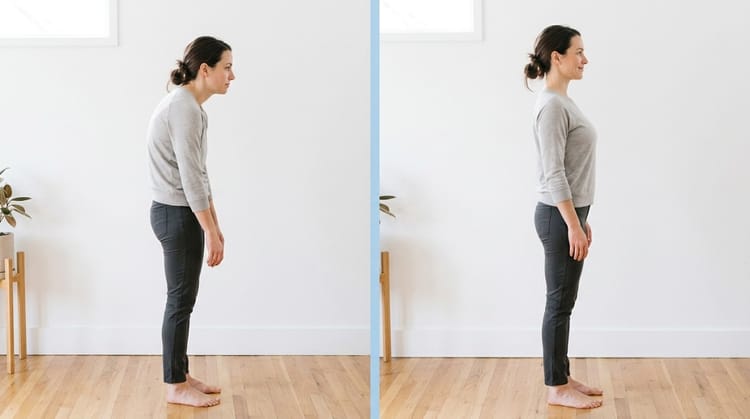
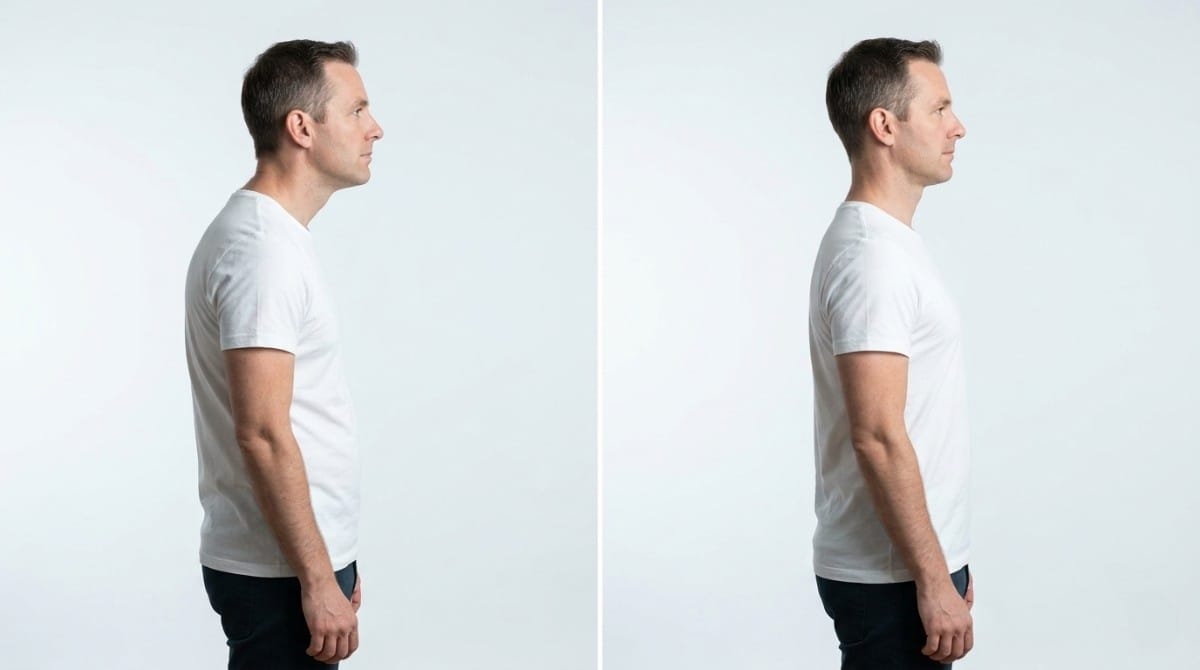
Forward head posture - sometimes called “text neck” or “scholar’s neck” - is a condition where the head consistently rests in a position in front of the body’s centre of gravity. In neutral alignment, the ear sits directly above the shoulder joint. In forward head posture, it sits ahead of it - often by 1 to 4 inches in desk workers and heavy phone users.
This sounds minor. The mechanical consequences are not.
The human head weighs approximately 10 to 12 pounds in neutral alignment. For every inch it shifts forward, the effective load on the cervical spine roughly doubles. A head sitting 3 inches forward creates the equivalent of 30 to 40 pounds of force on the structures supporting it. Those structures - the neck muscles, cervical discs, and supporting ligaments - were not designed to manage that load indefinitely.
Why Does Forward Head Posture Develop?
The position is a direct product of how most people spend their waking hours:
• Looking down at a phone in the lap or on a desk
• Leaning toward a monitor that is too low or too close
• Reading with the chin forward and down
• Driving with the head extended toward the windshield
• Sitting in a reclined chair that pushes the head forward of the hips
Each of these activities is not a problem in short durations. The issue is volume and repetition. Hours of daily forward flexion gradually teaches the body to adopt the forward head position as its default - shortening the muscles at the back of the neck, weakening the muscles at the front, and altering the resting position of the skull on the cervical spine.
Why Does It Cause So Much Pain?
Forward head posture creates a predictable chain of compensations:
• The suboccipital muscles (base of the skull) shorten and compress to keep the eyes level
• The upper trapezius and levator scapulae overwork to support the unsupported head weight
• The deep cervical flexors - the muscles designed to stabilise the neck switch off from underuse
• The thoracic spine rounds to accommodate the forward shift, pulling the shoulders into internal rotation
• The chest and pectoralis minor tighten, further rounding the upper back
The result is a self-reinforcing cycle of tension, weakness, and pain that rarely resolves on its own without direct intervention.
Key Insight 💡: Forward head posture is not a neck problem in isolation. It is a full upper-body chain dysfunction. Treating only the neck produces partial, temporary results. Lasting correction requires addressing the chest, thoracic spine, deep neck, and mid-back together.
What Happens If Forward Head Posture Goes Uncorrected?
Posture specialists suggest that untreated forward head posture progresses through identifiable stages:
• Stage 1: Occasional stiffness and fatigue in the neck and upper shoulders
• Stage 2: Persistent tension headaches, reduced neck range of motion
• Stage 3: Nerve-related symptoms including tingling or weakness in the arms, chronic cervicogenic headaches
• Stage 4 (advanced): Structural cervical disc changes, thoracic outlet syndrome, significant loss of mobility
Most people reading this article are in Stage 1 or 2. At this level, consistent corrective exercise produces strong and lasting results.

The Two-Part Fix: Release and Rebuild
Correcting forward head posture requires two things happening simultaneously:
1. Release the structures that are pulling the head forward. The suboccipital muscles, upper trapezius, levator scapulae, pectoral muscles, and anterior shoulder capsule all shorten in forward head posture. Until they are mobilised and lengthened, any strengthening work fights against their pull.
2. Rebuild the structures that should be holding the head back. The deep cervical flexors (longus colli and longus capitis), the mid-lower trapezius, and the rhomboids are chronically underactivated in forward head posture. These are the muscles that create and maintain neutral head position. They must be progressively strengthened.
|
Release
(Tight) |
Rebuild
(Weak) |
|
Suboccipital
muscles |
Deep
cervical flexors |
|
Upper
trapezius |
Mid
and lower trapezius |
|
Levator
scapulae |
Rhomboids |
|
Pectoralis
minor |
Serratus
anterior |
|
Anterior
scalenes |
Deep
neck stabilisers |
Most people do one or the other. Release without rebuilding means the head drifts forward again within hours. Rebuilding without releasing means the strengthening muscles work against shortened antagonists and cannot reach full function. Both must happen together.
Best Exercises for Forward Head Posture (Quick List)
1. Chin Tuck - The primary corrective exercise for forward head posture. Directly trains the deep cervical flexors and repositions the skull over the spine.
2. Suboccipital Release / Neck Stretch - Releases the compressed muscles at the base of the skull that are the most common source of tension headaches in forward head posture.
3. Chest Opener Stretch - Lengthens the pectoral muscles pulling the shoulders and upper back into the rounded position that supports forward head posture.
4. Thoracic Extension over Foam Roller or Chair - Restores the extension range of motion lost in the upper back - essential for the thoracic spine to support upright head position.
5. Thoracic Spine Rotation - Opens the upper back rotationally and prevents the rigid thoracic restriction that forces the neck to compensate.
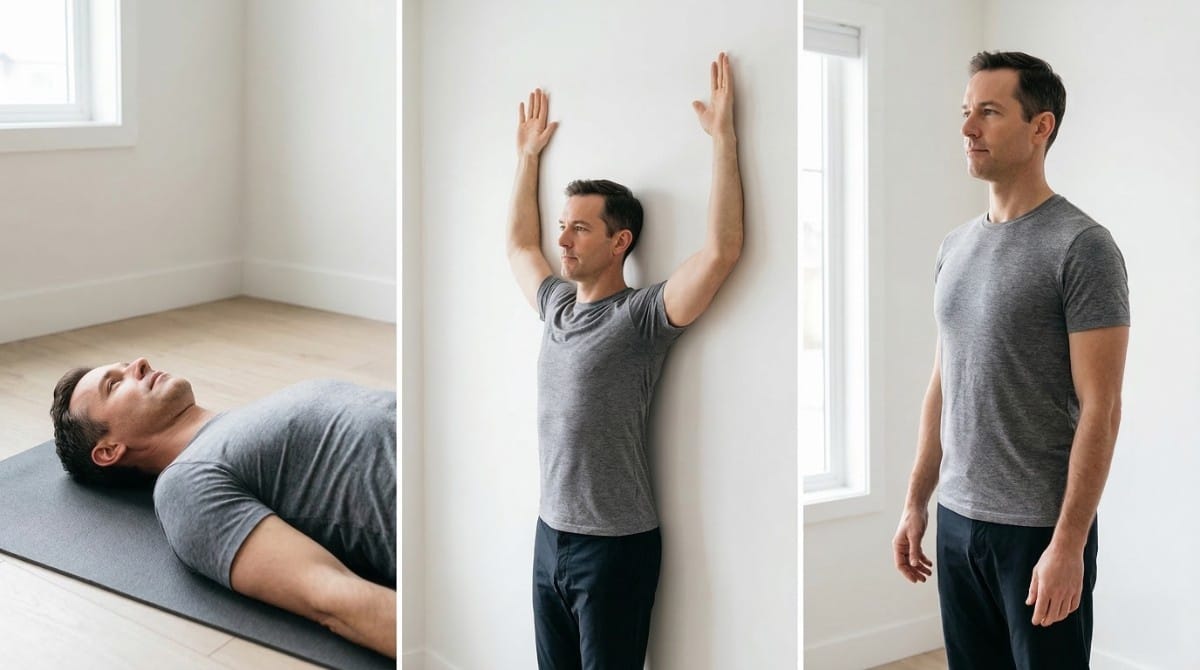
6. Wall Angels - Trains the mid and lower trapezius to hold the shoulder blades in the retracted position that allows the head to sit back over the spine.
7. Deep Neck Flexor Strengthening (Nodding Exercise) - Rebuilds the specific muscles most responsible for maintaining neutral cervical alignment.
8. Face Pull / Isometric Row - Strengthens the posterior shoulder and mid-back complex that provides the structural base for correct head position.
9. Doorway Pec Stretch - Targets the pectoralis major and minor with more depth than a standard chest opener - useful when chest tightness is severe.
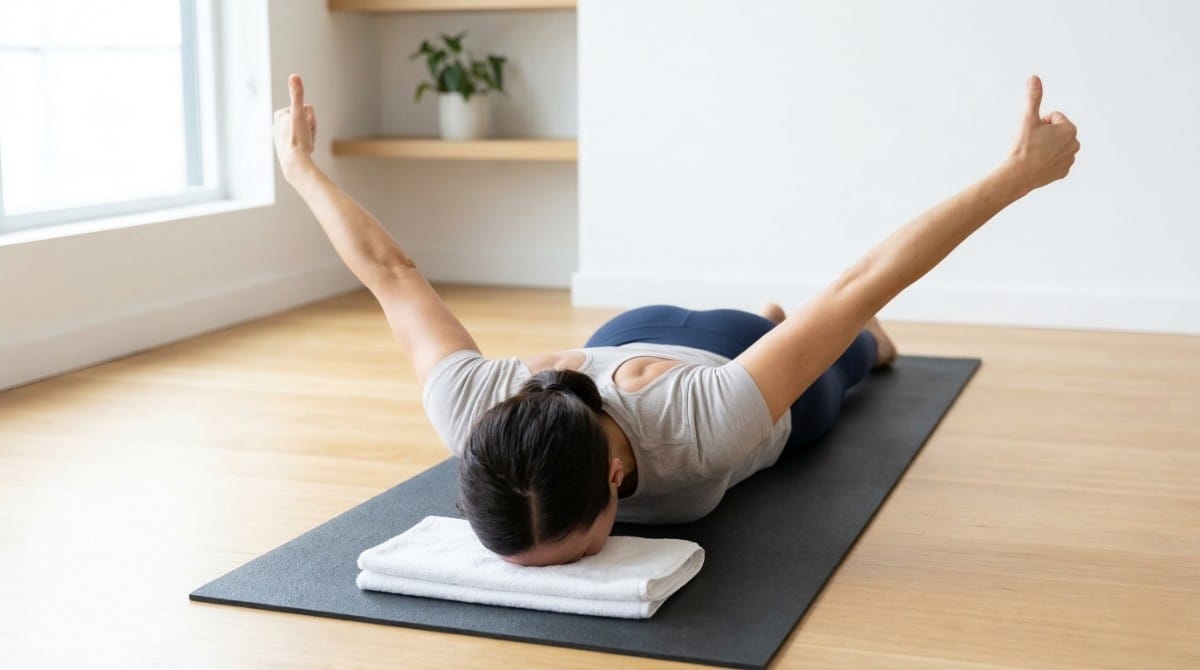
10. Prone Y-T-W Raises - Rebuilds the lower and mid trapezius from the floor - a physiotherapy staple for forward head and rounded shoulder correction.
Step-by-Step Recovery Framework
Phase 1 – Weeks 1 to 2: Release the Lock
Before strengthening is possible, the tight structures must be mobilised. In Phase 1, every session focuses on releasing the suboccipital muscles, chest, and thoracic spine.
Daily routine (8 to 10 minutes):
1. Suboccipital neck stretch – 30 seconds each side
2. Chin tuck (lying down) – 2 x 10 reps
3. Chest opener stretch – 3 x 30 seconds
4. Thoracic extension over chair back – 60 seconds
5. Thoracic spine rotation – 8 reps each side
Phase 2 – Weeks 3 to 5: Rebuild the Foundation
Add the strengthening exercises progressively. Continue the Phase 1 mobility work as the warm-up before each session.
Add to routine:
1. Wall angels – 2 x 10 reps
2. Deep neck flexor nodding – 2 x 12 reps
3. Prone Y raises – 2 x 10 reps
4. Isometric row – 3 x 10 reps (3-second hold)
Phase 3 – Weeks 6 onwards: Integrate and Progress
Increase volume and introduce movement integration. Begin extending the chin tuck into standing and walking. Add resistance to rows. Notice posture during daily activities and apply corrections consciously until they become automatic.
Exercise Breakdown: Key Movements Explained
1. Chin Tuck
The chin tuck is the single most important exercise for forward head posture correction. It directly trains the deep cervical flexors - longus colli and longus capitis - which are the primary muscles responsible for pulling the head back into neutral alignment.
It is deceptively simple. Most people do it wrong the first time.
How to do it (lying version - start here): 1. Lie on your back on a flat surface with no pillow 2. Keep your eyes looking straight at the ceiling 3. Gently draw your chin straight back - not down toward your chest, but back as if making a “double chin” 4. You should feel a light tension at the base of your skull and along the front of your neck 5. Hold for 5 seconds, relax fully, repeat 10 times
Progression - seated version: 1. Sit upright with your back lightly supported 2. Draw the chin straight back - the movement is horizontal, not downward 3. Hold 5 seconds, release 4. Complete 12 reps
Common mistake: Tucking the chin down toward the chest. The movement is a straight horizontal retraction - imagine the back of your head sliding along the wall behind you.
Frequency: 2 to 3 sets daily. This is the exercise where consistency produces the fastest results.
2. Suboccipital Release Stretch
The suboccipital muscles sit at the base of the skull and compress significantly in forward head posture. They are one of the most common sources of tension headaches in desk workers. This stretch directly targets them.
How to do it: 1. Sit upright in a chair 2. Drop your chin gently toward your chest - not forcefully, just allow the weight of your head to create a light stretch 3. Place both hands loosely behind your head for very gentle additional weight - do not pull 4. Breathe slowly and hold for 30 to 45 seconds 5. Lift your head slowly back to neutral, pause, repeat 2 more times
Common mistake: Pulling the head down with the hands. The hands are only resting - the weight of the head alone provides the stretch.
3. Thoracic Extension over Chair Back
This exercise restores the thoracic extension range of motion that forward head posture and rounded upper back eliminate. Without thoracic extension, the head cannot sit over the shoulders regardless of how strong the neck muscles become.
How to do it: 1. Sit in a firm chair and shuffle forward so your upper back rests against the top edge of the chair back 2. The edge should be at approximately mid-to-upper thoracic level - not the lower back 3. Support your head with both hands behind it 4. Gently allow your upper back to extend over the edge of the chair - moving into gentle upper back extension 5. Hold for 3 to 5 slow breaths 6. Move your position up slightly and repeat at a different thoracic level 7. Complete the sequence 2 to 3 times
Common mistake: Extending from the lower back rather than the upper back. The movement should be felt in the mid-upper spine - not the lumbar region.

4. Prone Y-T-W Raises
These floor-based exercises rebuild the lower and mid trapezius - the muscles most responsible for pulling the shoulder blades down and back, providing the structural base from which the head can sit back over the spine. They are a physiotherapy staple for upper body postural correction.
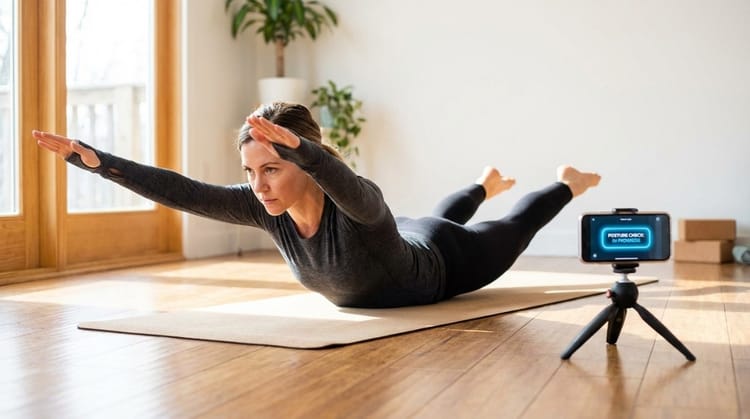
How to do it (Y raise): 1. Lie face down on a mat with your forehead resting lightly on the floor or a folded towel 2. Extend both arms above your head in a Y shape - thumbs pointing toward the ceiling 3. Squeeze your shoulder blades down and together as you lift both arms a few inches off the floor 4. Hold for 3 seconds, lower slowly 5. Repeat 10 times
T raise (same position): Extend arms out to the sides in a T shape, thumbs pointing up. Lift, hold 3 seconds, lower slowly. 10 reps.
W raise: Bend elbows to 90 degrees in a W shape, thumbs pointing up. Squeeze shoulder blades hard and lift. 10 reps.
Common mistake: Shrugging the shoulders toward the ears during the raise. Focus on driving the shoulder blades DOWN away from the ears before and during the lift.
5. Wall Angels
Wall angels train the shoulder blade movement pattern needed to hold the scapulae in the retracted and depressed position - which directly relieves the upper trapezius overactivation driving neck tension.
How to do it: 1. Stand with back against a wall - feet 6 inches from the baseboard 2. Press the lower back, upper back, and back of the head lightly against the wall 3. Raise arms into a “W” position - elbows bent, backs of hands touching the wall 4. Slowly slide arms overhead into a “Y” keeping full wall contact throughout 5. Lower slowly back to “W” 6. Repeat 10 reps
Common mistake: Losing wall contact with the hands or lower back as arms rise. Reduce the range of movement rather than losing contact.
Posture Habits That Make Forward Head Posture Worse
Exercises will not hold if daily habits continue to drive the head forward. Alongside the exercise routine, address these:
• Phone position: Hold your phone at eye level as much as possible. “Text neck” is a direct product of looking down at a device held in the lap.
• Monitor height: The top of your monitor should be at or just below eye level. A screen that is too low forces the head into chronic forward flexion.
• Driving position: Adjust the headrest so your head rests against it in neutral. Most people drive with the head forward of the headrest.
• Pillow height: A pillow that is too thick pushes the head forward during sleep - reinforcing the exact position you are trying to correct during the day.
• Reading posture: Bring the book or device to eye level. Reading flat on a desk is one of the highest-load positions for the cervical spine.
When This Approach Does Not Work
Corrective exercises are effective for the majority of people with posture-driven forward head position. Seek clinical assessment if:
• Pain radiates from the neck down the arm, or numbness and tingling are present
• Headaches are severe, sudden, or different in character from tension headaches
• Neck movement is significantly restricted in one or more directions
• Symptoms worsen consistently with exercise rather than gradually improving
• You have a diagnosed cervical disc condition, spinal stenosis, or prior neck injury
At Stage 1 and 2 - the level most people search this topic - corrective exercise is safe and produces strong results. At Stage 3 and beyond, a physiotherapist or sports medicine physician should guide the program.
Research and Expert Insight
Forward head posture and its correction are well-studied in musculoskeletal rehabilitation science.
• Research in cervical spine rehabilitation shows that deep cervical flexor training - specifically the chin tuck and progressive neck stabilisation exercises - significantly reduces neck pain and improves head position in people with chronic forward head posture.
• Physiotherapists often recommend a combined protocol of thoracic mobilisation and cervical strengthening, rather than neck stretching alone, as the most effective evidence-based approach.
• Posture specialists suggest that the thoracic spine is the most overlooked contributor to forward head posture - restoring thoracic extension often produces immediate improvements in cervical alignment without direct neck work.
• Studies in occupational health consistently identify screen time and desk work as the primary environmental drivers of forward head posture in adults under 50.
• Research into deep neck flexor endurance shows that this capacity is significantly reduced in people with chronic neck pain compared to pain-free controls - making targeted deep flexor strengthening a clinical priority.
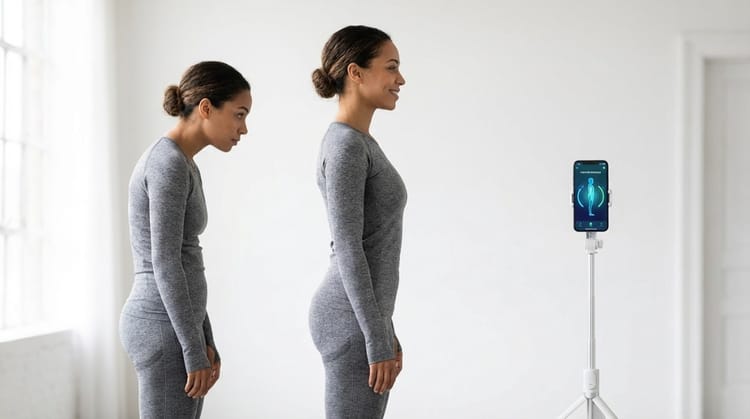
Forward head posture looks different on every body. The degree of suboccipital compression, the level of thoracic restriction, the depth of deep flexor weakness - these vary significantly. Backed AI scans your posture with your phone camera and builds a corrective program around your specific cervical alignment pattern. No generic list. A plan built for your head position. Try Backed AI free →
Final Takeaway
Forward head posture is not permanent. It is a muscle imbalance pattern driven by modern screen habits - and it responds well to targeted, consistent corrective exercise.
The most important things to get right:
• Do the chin tuck daily. It is the most evidence-backed exercise for this condition and the one most people skip because it looks too simple.
• Restore thoracic extension. The neck cannot correct in isolation if the upper back remains rigidly rounded.
• Rebuild the deep flexors AND the mid-back. Releasing tightness without rebuilding strength will not hold.
• Change one or two daily habits. Monitor height, phone position, and pillow thickness all feed or fight the correction.
Four to eight weeks of consistent practice typically produces clear, measurable improvement. Six months produces lasting correction.
Start today. Your head will thank you.
Why Most Forward Head Posture Fixes Do Not Last
The internet is full of forward head posture content. Most of it fails people for the same reasons:
1. Chin tucks in isolation. The chin tuck is essential - but without thoracic extension work and deep flexor strengthening, the head drifts forward again within hours of practice.
2. No assessment of severity. Mild forward head posture requires different exercise priorities than severe chronic cases. Generic programs cannot account for this.
3. Stretching without strengthening. Releasing the suboccipitals and chest provides relief. Without rebuilding the deep cervical flexors and mid-back, the tight muscles return to their shortened state.
4. No progression. Most articles give you a set of exercises with no structured path forward. When results plateau - and they will without progression - most people assume the approach does not work and stop.
5. Habits not addressed. If the monitor stays too low and the phone stays in the lap, exercises are fighting against the same forces every day. The environmental drivers must be addressed alongside the exercise program.
The Smarter Alternative for Forward Head Posture 📱
Backed AI solves the personalisation problem that generic content cannot.
• 🔍 AI posture scan – Your phone camera analyses your head position, cervical alignment, and upper back curvature, identifying the specific pattern driving your forward head posture.
• 📋 Personalised corrective program – Instead of a generic 10-exercise list, you receive a structured program built around your specific imbalance severity and contributing factors.
• 📈 Progress tracking – Your head position is tracked over time. You can see the correction happening - which is one of the most powerful motivators for maintaining consistency.
The difference between a generic article and a personalised program is the difference between knowing what to do and knowing what to do for your body.
Download Backed AI and start correcting your posture today. → backedapp.com
Frequently Asked Questions
Q1: How long does it take to correct forward head posture? Most people notice reduced neck tension and improved awareness within 2 to 3 weeks of daily practice. Visible correction in head position typically becomes measurable after 4 to 8 weeks. Full correction of long-standing patterns where the head has been forward for months or years - may take 3 to 6 months of consistent exercise and habit adjustment.
Q2: What is the most effective exercise for forward head posture? The chin tuck is the most evidence-supported exercise for forward head posture correction. It directly targets the deep cervical flexors - the muscles most responsible for maintaining neutral head position. It should be done daily in both the lying and seated versions, 2 to 3 sets of 10 to 12 reps.
Q3: Can forward head posture be fully corrected in adults? For most adults with posture-driven forward head position - caused by screen use, desk work, and daily habits - yes. The condition is a muscular and neurological pattern, not a structural one at early and moderate stages. With consistent targeted exercise and habit modification, meaningful and lasting correction is achievable.
Q4: Does sleeping position affect forward head posture? Yes. A pillow that is too thick pushes the head forward during sleep - reinforcing the same forward head position you are working to correct during the day. A pillow that keeps the head in a neutral position (ears level with the shoulders when side sleeping) supports recovery. Stomach sleeping is the most disruptive position for cervical alignment.
Q5: Is forward head posture causing my headaches? It is a very common contributor. The suboccipital muscles at the base of the skull become chronically compressed in forward head posture, and their trigger points refer pain to the back and sides of the head - producing what feels like a tension headache. Correcting the forward head position and releasing the suboccipital typically reduces headache frequency in people where posture is the primary driver.