How to Fix Your Posture in 30 Days: The Science-Backed Plan That Actually Works

You can genuinely improve your posture in 30 days – if you follow the right sequence of stretching, strengthening, and daily habit changes. Most people fail not because posture correction is hard, but because they use generic exercises without understanding why their posture broke down in the first place.
TL;DR
- Poor posture is caused by muscle imbalances, not laziness
- Fixing it requires both stretching tight muscles and strengthening weak ones
- Results take 30 days of consistent daily effort
- Desk workers, phone users, and parents are at highest risk
- AI-powered tools like Backed AI can personalize your plan and track real progress
What Is Poor Posture?
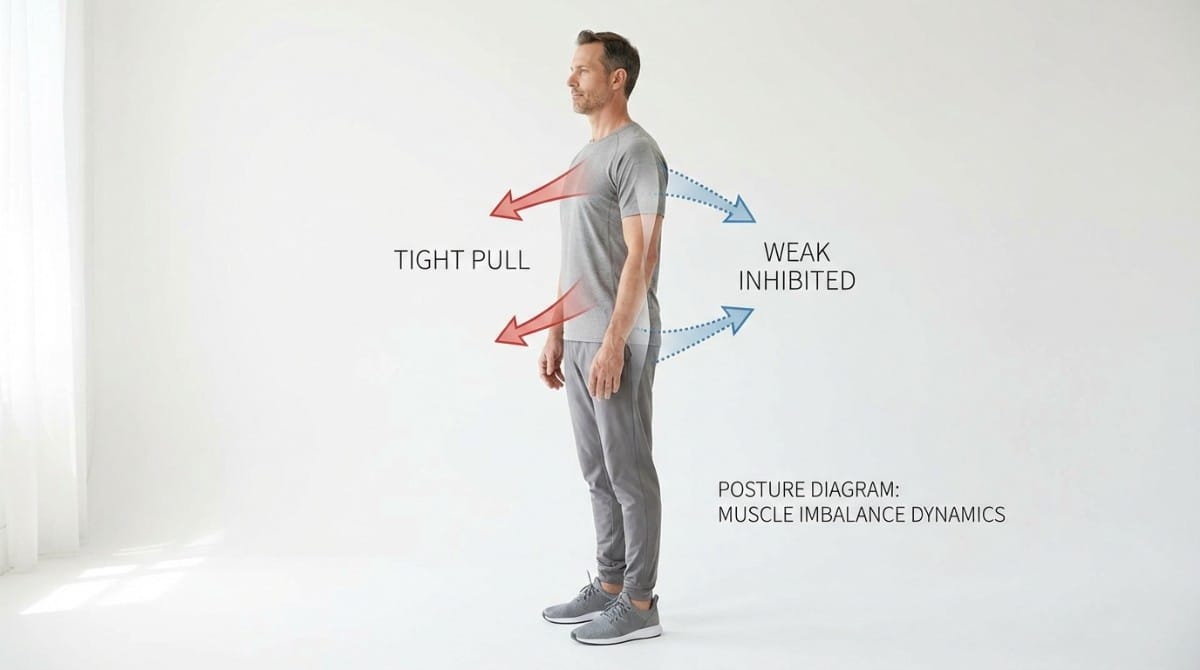
Poor posture is a musculoskeletal imbalance where certain muscles become overactive and tight while opposing muscles weaken, pulling the skeleton out of neutral alignment.
This isn't just about slouching. It's a structural problem that builds up over months and years of sitting, scrolling, and stress. Your bones and joints follow wherever your muscles pull them.
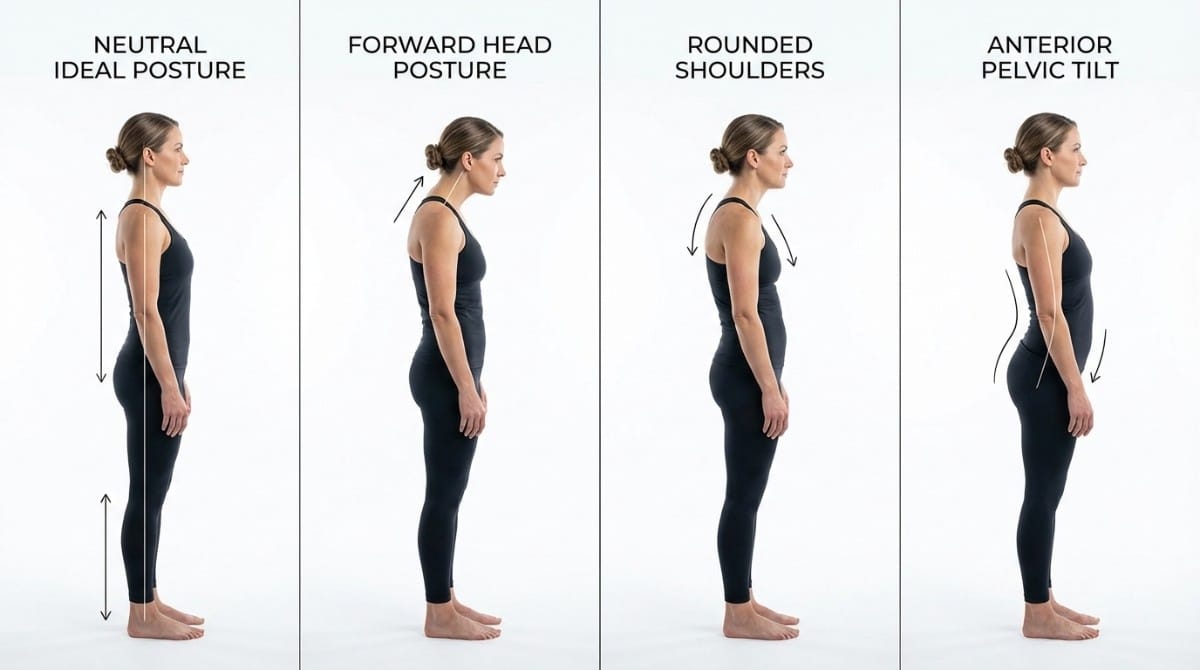
The most common patterns include:
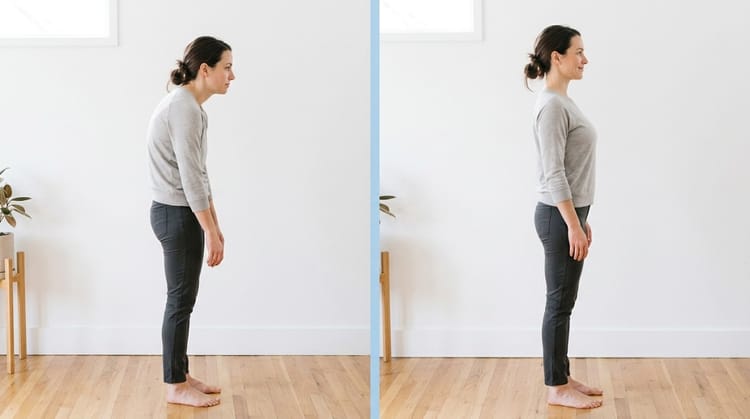
- Forward head posture – head drifts in front of the shoulders
- Rounded shoulders – chest collapses inward, upper back rounds
- Anterior pelvic tilt – lower back arches excessively, belly tips forward
- Kyphosis (hunchback posture) – excessive upper spine curve
Most people have a combination of two or more of these patterns at once.
Why Does Poor Posture Develop?
The human body adapts to the positions it holds most often. Spend 8 hours a day at a desk and your hip flexors shorten, your chest tightens, and your upper back rounds to follow the screen.
Four main drivers:
- Prolonged sitting – compresses spinal discs, weakens glutes and deep core
- Screen time – pulls the head forward, straining neck extensors
- Stress and fatigue – causes chronic muscle bracing and collapse
- Weak posterior chain – when glutes, mid-back, and deep neck flexors are underdeveloped, the body compensates with poor alignment
Posture specialists suggest that it isn't just physical. Emotional stress contributes to rounding the shoulders and tightening the chest -- the body's natural protective posture.
How Does Poor Posture Affect Your Daily Life?
The consequences extend far beyond back pain. Research in musculoskeletal rehab shows that chronic poor alignment affects breathing capacity, digestion, mood, and even confidence.
Common effects include:
- Persistent neck and upper back pain
- Tension headaches from tight suboccipital muscles
- Shallow breathing from compressed rib cage
- Reduced height and "shrinking" appearance
- Lower energy and concentration at work
- Self-consciousness about appearance in social and professional settings
For parents, the constant bending over children adds load. For desk workers, the 8-hour slump compounds daily. For older adults, it accelerates spinal degeneration.
What Happens If You Ignore Poor Posture?
Left uncorrected, posture imbalances become structural. The soft tissue adapts to its shortened or lengthened position -- a process called adaptive shortening and lengthening. Over time:
- Spinal discs experience uneven pressure, increasing risk of herniation
- Nerves become compressed, causing radiating pain (sciatica, nerve pain in arms)
- Joint surfaces wear unevenly, accelerating osteoarthritis
- Breathing mechanics decline as the rib cage loses mobility
Physiotherapists often recommend addressing posture early -- before symptoms become chronic -- because tissue adaptation becomes harder to reverse with age.
💡 Key Insight: You don't just fix posture by standing up straight. You have to release the tight muscles pulling you out of alignment AND strengthen the weak muscles that can't hold you in place. Both steps are non-negotiable.
The 30-Day Posture Correction Plan: Phase by Phase
Phase 1 (Days 1-7): Build Awareness and Release Tension
Before strengthening anything, you need to release what's tight.
Physiotherapists often recommend starting with spinal elongation and flexibility work before loading any muscles – otherwise you're strengthening the body into a bad position.
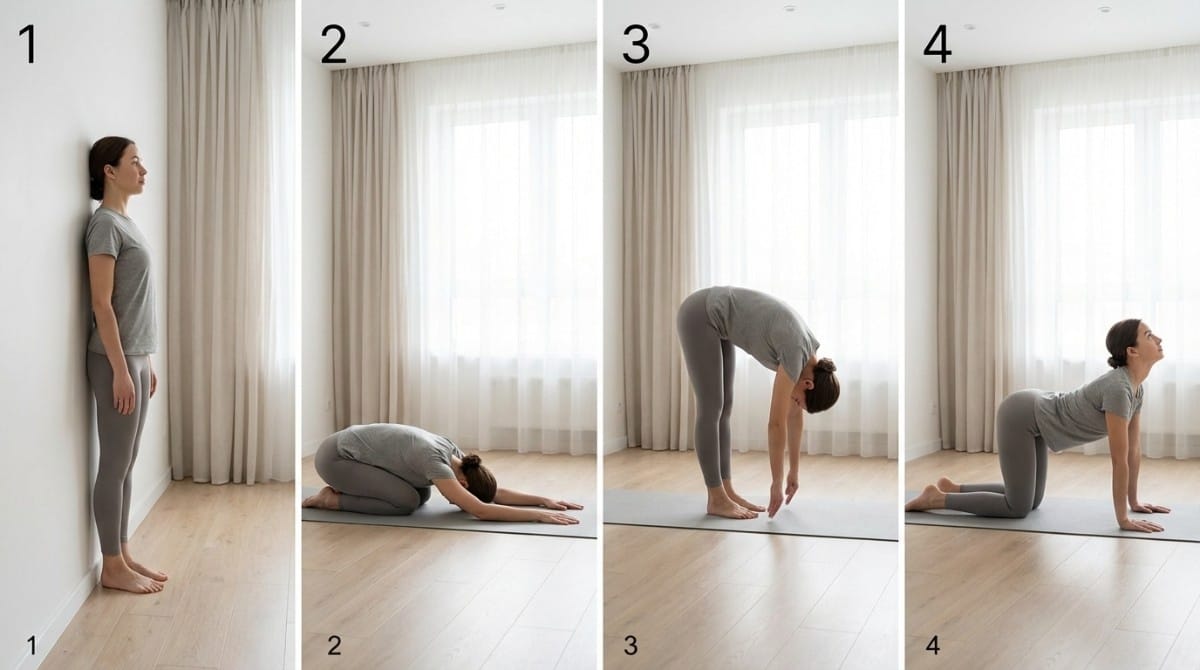
Daily routine for Week 1 (10-15 minutes, morning and evening):
- Wall posture check – Stand with heels 6 inches from the wall. Your head, upper back, and glutes should touch the wall with less than 2 inches of gap behind your neck and lower back. This is your target position. Hold for 60 seconds.
- Child's Pose – Kneel, extend arms forward, drop forehead to floor. Hold 5 deep breaths. Repeat 3 times. Decompresses the lumbar spine and gently stretches tight thoracic extensors.
- Standing Forward Fold – Feet hip-width apart. Bend at the hips (not waist), let head hang heavy. Hold 30 seconds, 3 rounds. Releases hamstrings and lower back tension.
- Cat-Cow – On all fours, alternate between arching and rounding your spine slowly with the breath. 10 cycles. Restores spinal mobility and resets postural awareness.
- Chest Opener Stretch – Clasp hands behind lower back, lift chest toward ceiling. Hold 5 breaths, twice daily. Directly counteracts desk-induced chest tightening.
Phase 2 (Days 8-14): Activate Weak Muscles
Now the tight muscles are releasing. It's time to wake up the ones that have been switched off.
Add to your daily routine:
- High Plank – Arms straight, wrists under shoulders. Hold for 10 deep breaths, 3-5 rounds. Activates deep core stabilizers essential for upright posture.
- Downward-Facing Dog – From all fours, push hips high and back. Press heels toward the floor. Hold 5 breaths. Opens chest and anterior shoulder while activating upper back.
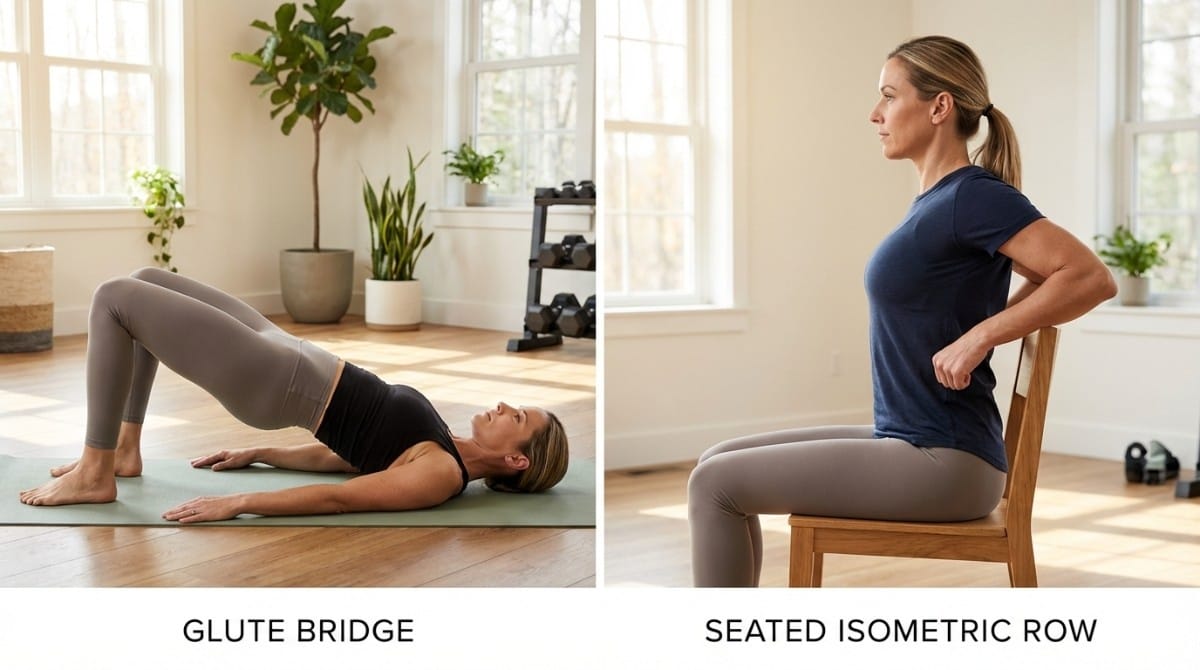
- Glute Bridge – Lie on back, feet flat, drive hips up. Hold 2 seconds at top. 3 sets of 12 reps. Reactivates inhibited glutes that allow anterior pelvic tilt.
- Isometric Row (seated) – Sit upright. Drive elbows back into your seat, squeeze shoulder blades together hard. Hold 10 seconds. Repeat for 1 minute every 2 hours. Activates rhomboids and mid-traps – the muscles most responsible for pulling shoulders back.
- Pigeon Pose – From Downward Dog, bring one knee forward toward the same-side hand. Lower torso toward the floor. Hold 30 seconds per side. Releases tight hip flexors that cause anterior pelvic tilt.
💡 Desk worker tip: Set a phone reminder every 2 hours. Each time it fires, stand up and do 30--60 seconds of isometric rows in your chair before continuing work.
Phase 3 (Days 15-21): Build Postural Endurance
Awareness and activation only work if your body can hold the position under load – like a full workday.
Add to your daily routine:
- Side Plank – Hold each side for 20-30 seconds, 2 rounds. Strengthens lateral core stabilizers that prevent spinal collapse under sustained load.
- Thoracic Spine Rotation – Lie on your side, knees bent. Reach top arm across to the ceiling and let it fall behind you. 5-10 slow repetitions each side. Restores mid-back rotation lost from desk posture.
- Hip Flexor Lunge Stretch – Step forward into a lunge. Drop back knee. Tuck tailbone slightly. Reach arms up. Hold 30 seconds per side. Directly counteracts hip flexor tightening from prolonged sitting.
- Standing Cat-Cow – Stand hip-width apart. Place hands on thighs. Alternate between arching and rounding the upper back slowly. 10 cycles. Transfers spinal awareness from the floor to the upright position – much more applicable to daily life.
Movement break protocol: Set an alarm every 20 minutes while working. Each time it fires, stand up and spend 30 seconds doing either Standing Cat-Cow or a chest opener. This prevents postural fatigue from compounding through the day.
Phase 4 (Days 22-30): Ingrain the Habit
This week is about making the new alignment feel normal, not forced.
Increase volume and lifestyle integration:
- Increase plank holds to 4-5 sets daily
- Add Isometric Rows every hour instead of every 2 hours
- Stand for 35-50% of your workday using a makeshift standing surface if needed
- Practice the wall check twice daily – morning and before bed
- Add a 5-minute yoga session focused on thoracic spine mobility every other day
Best Exercises for Posture Correction (Quick List)
- Wall Posture Check – Resets your body's alignment baseline. Do daily.
- Cat-Cow – Restores spinal mobility lost from sitting. Do morning and night.
- Chest Opener Stretch – Reverses desk-driven chest tightness. Do 3x daily.
- Glute Bridge – Reactivates switched-off glutes. 3 sets of 12.
- High Plank – Builds the core stability needed to hold posture under load. 3--5 rounds.
- Isometric Row – Activates upper back to pull shoulders back. Every 2 hours.
- Pigeon Pose / Hip Flexor Stretch – Releases tight hips driving anterior pelvic tilt. Daily.
- Thoracic Spine Rotation – Restores mid-back mobility. Daily.
Posture Correction: What to Expect Week by Week
| Week | Primary Focus | What You'll Notice |
|---|---|---|
| Week 1 | Release tight muscles | Less morning stiffness, slightly taller feeling |
| Week 2 | Activate weak muscles | Glutes and upper back feel worked, more upright at rest |
| Week 3 | Build endurance | Posture holds longer without effort, fewer midday collapses |
| Week 4 | Habit integration | Upright posture starts to feel natural, less reminding needed |
When This Approach Doesn't Work
Posture correction exercises are effective for most people -- but not all cases respond the same way.
This plan may be insufficient if you have:
- A diagnosed spinal condition (herniated disc, scoliosis, spinal stenosis) – consult a physiotherapist before attempting corrective exercises
- Nerve pain or radiating symptoms (numbness, tingling into the arms or legs) – this may indicate nerve compression requiring clinical assessment
- Structural hypermobility – some joints are already too mobile; strengthening without a tailored protocol can increase instability
- Chronic pain that worsens with exercise – a sign that tissue irritation needs to settle before loading begins
If pain increases during any phase, stop the aggravating exercise and seek a professional opinion before continuing.
Step-by-Step Recovery Framework
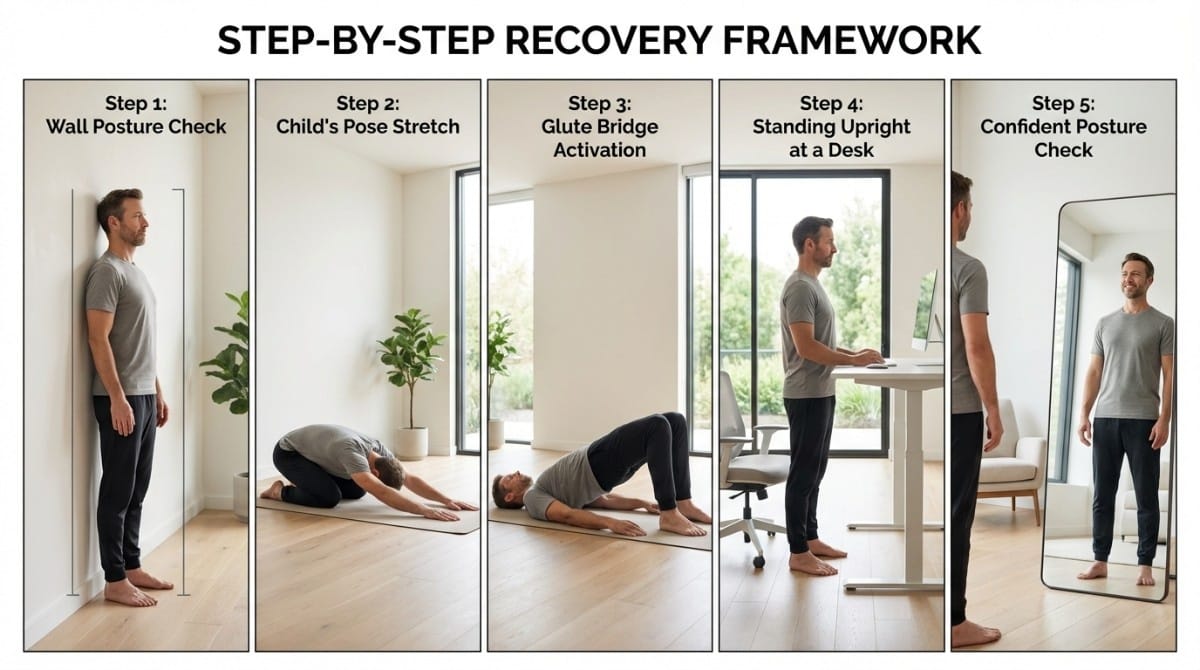
Step 1 – Identify your posture pattern. Use the wall test to understand where your alignment breaks down: head position, shoulder position, lower back curve.
Step 2 – Release the tight side first. Focus Week 1 on stretching, not strengthening. Loading a tight muscle deepens the imbalance.
Step 3 – Activate the inhibited muscles. Week 2 targets the glutes, deep core, and mid-upper back -- the muscles that support neutral spine under load.
Step 4 – Build endurance under load. Week 3 extends the time your muscles can hold correct alignment -- necessary for desk workers and parents who can't rest every 20 minutes.
Step 5 – Integrate into daily habits. Week 4 embeds the new pattern into your morning routine, desk habits, and movement breaks so it continues without effort.
Research & Expert Insight
Posture correction is well-supported by musculoskeletal research. Key evidence points:
- Research in spinal biomechanics shows that every inch the head shifts forward adds approximately 10 pounds of effective load on the cervical spine – making forward head posture one of the fastest drivers of neck degeneration.
- Physiotherapists often recommend a combination of soft tissue release and motor re-education for best outcomes – not exercises alone.
- Posture specialists suggest that habit-level reminders (movement break alarms, environmental cues) are as important as the exercises themselves for long-term correction.
- Research in musculoskeletal rehab shows that it typically takes 6-8 weeks to build meaningful muscle memory in postural muscles – the first 30 days creates the foundation.
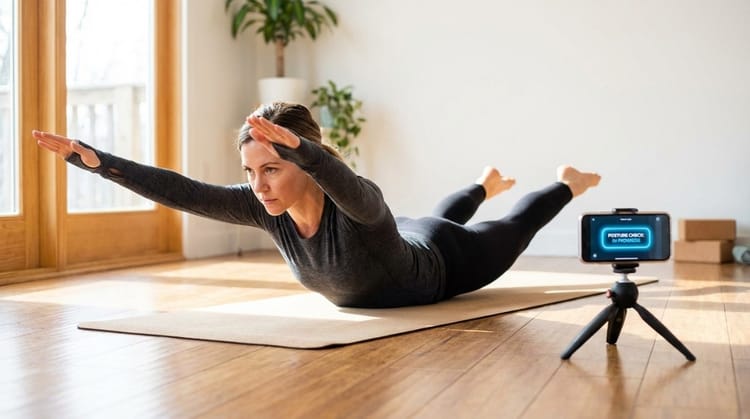
Want to track your posture improvements with data rather than guesswork? Backed AI uses camera-based posture scanning to show you exactly where your alignment is off – and builds a corrective program around your specific pattern. It takes the guesswork out of the process entirely.
Final Takeaway
Posture correction in 30 days is achievable – but only if you follow the right sequence. The key insight most generic guides miss is this: you must release before you strengthen. Tight muscles must be lengthened before weak muscles can activate properly.
Follow the 4-phase plan, set movement break reminders, and stay consistent for all 30 days. Most people notice real changes by Day 14. By Day 30, the new posture starts to feel automatic.
Why Most Exercise Plans Fail – And What to Do Instead
Most people searching for posture fixes try a YouTube routine for a week, lose track of it, and revert to their old patterns by the end of the month.
The reason isn't motivation. It's three structural problems:
- No personalization. Generic routines target average bodies. Your posture pattern, mobility limitations, and history are unique. A one-size-fits-all program rarely targets the right muscles at the right intensity for you.
- Wrong form, no feedback. Without someone checking your movement, you can do exercises for weeks and reinforce the wrong patterns without knowing it.
- No progression. Posture correction requires increasing challenge as muscles adapt. Most static routines don't adjust as you improve – so results stall quickly.
The Smarter Alternative: Backed AI 📱
Backed AI is an AI-powered posture correction and back pain relief app designed to solve all three problems.
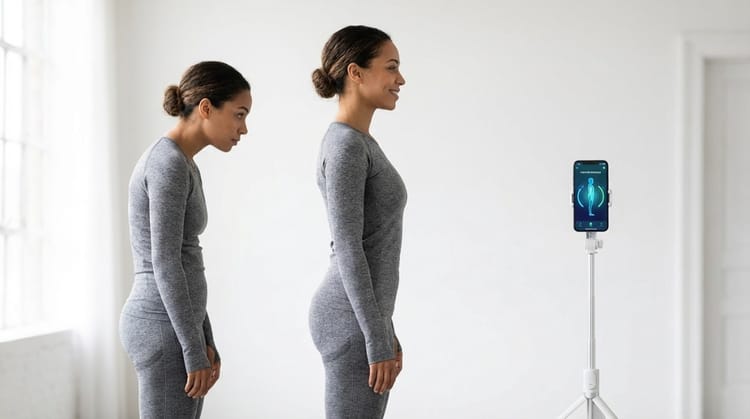
- AI posture analysis scans your alignment using your phone camera and identifies your specific postural deviations – not a generic guess
- Personalized corrective programs are built around your scan results and updated as you progress
- Smart habit-building reminders keep your movement breaks and daily routines consistent without relying on willpower
Instead of following a routine built for someone else, Backed AI builds one built for you – and adjusts it as your posture improves.
Whether you're a desk worker dealing with chronic neck pain, a parent with lower back stiffness, or someone who simply wants to stand taller and feel more confident, Backed AI gives you a clear, science-backed path forward.
Download Backed AI and start correcting your posture today: backedapp.com
FAQ
Q1: Can you really fix your posture in 30 days?
You can make significant, noticeable improvements in 30 days with consistent effort. Most people experience reduced stiffness and more natural upright alignment by week two. Full correction of long-standing imbalances typically takes 6--12 weeks, but 30 days builds the critical foundation.
Q2: What are the most effective exercises for posture correction? The most effective exercises combine stretching tight muscles (chest, hip flexors, thoracic spine) with activating weak ones (glutes, deep core, mid-upper back). The top moves are: chest opener stretch, glute bridge, cat-cow, high plank, and isometric rows.
Q3: How long does it take to see results from posture exercises?
Most people notice reduced tension and a taller, more upright feeling within 7-14 days. Structural muscle memory takes 6-8 weeks to develop. Consistency – especially daily movement breaks – accelerates results significantly.
Q4: Why does my posture get worse after sitting all day?
Prolonged sitting causes hip flexors to shorten, glutes to switch off, and the thoracic spine to round. Over an 8-hour workday, these effects compound. This is why movement breaks every 20-30 minutes are essential – not just morning and evening exercises.
Q5: Is an app like Backed AI better than YouTube posture exercises? For most people, yes. YouTube routines are generic and don't account for your specific postural pattern, mobility level, or progression. Apps like Backed AI use AI posture scanning to identify exactly where your alignment breaks down and build a personalized program around it – which is more efficient and produces faster results.