How to Open Your Chest and Improve Posture in 10 Minutes a Day
You can meaningfully improve your posture and relieve chest tightness in 10 minutes a day - if you target the right muscles in the right order. This guide gives you a complete, science-backed chest-opening routine built specifically for desk workers, phone users, and anyone whose upper body has slowly collapsed forward.
Chest opening for posture is the practice of systematically stretching shortened anterior muscles and reactivating weakened posterior muscles to restore natural spinal alignment and rib cage mobility.
No equipment required. No gym needed. Just consistency.
TL;DR
- 📌 A tight chest is one of the most common drivers of poor posture and upper back pain
- 📌 10 focused minutes daily is enough to create real, lasting change
- 📌 You need to both stretch the front and strengthen the back - not just stretch
- 📌 Desk workers and phone users are most at risk from chronic chest tightening
- 📌 Breathing retraining is a hidden but essential part of chest opening
- 📌 Consistency matters far more than duration - daily beats occasional long sessions
- 📌 Personalized routines produce faster results than generic stretch videos
What Is a Tight Chest - and Why Does It Happen?
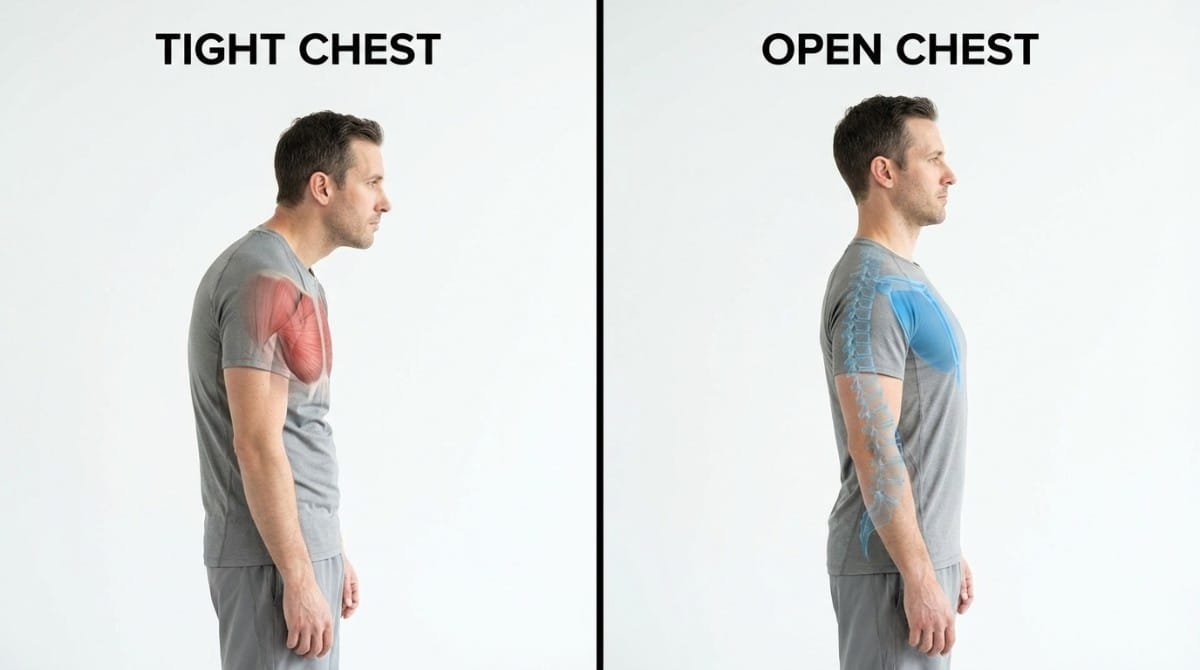
A tight chest is not just a feeling. It is a physical adaptation.
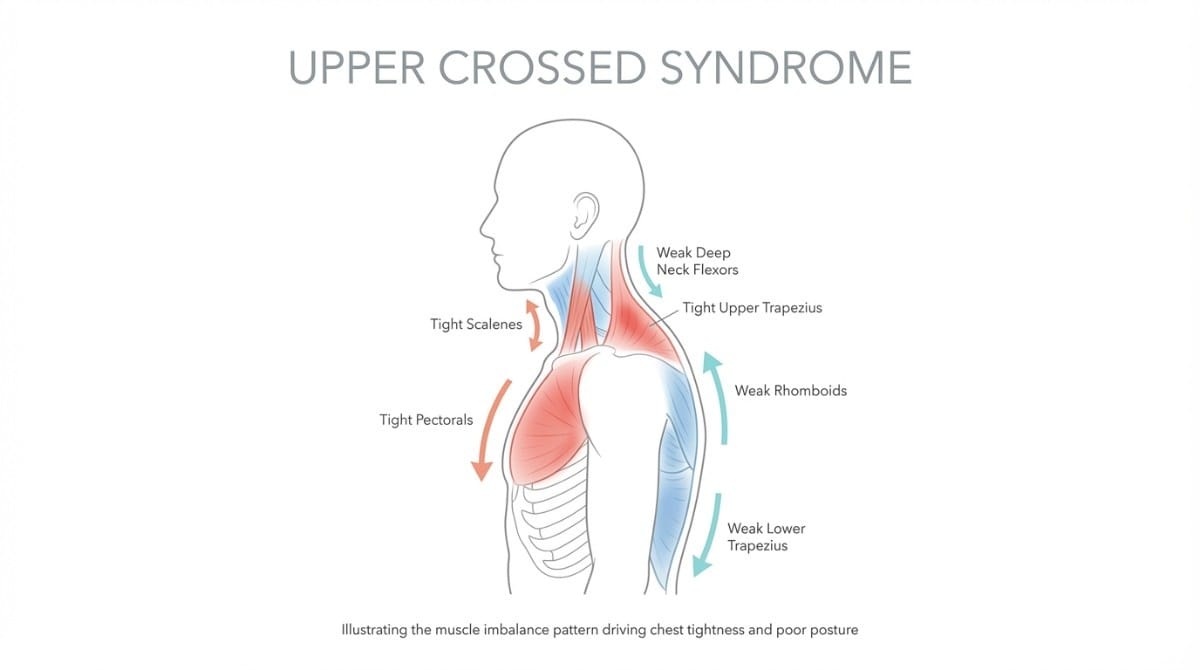
When you sit hunched over a desk, lean into a phone screen, or drive for long periods, your pectoral muscles (chest), anterior deltoids (front of shoulders), and scalenes (neck) spend hours in a shortened position. Over time, they adapt to that shortened length.
Meanwhile, the muscles on the opposite side - your rhomboids, middle trapezius, and deep neck flexors - become long, weak, and underactive. They stop doing their job of pulling you upright.
The result is what physiotherapists call upper crossed syndrome: a predictable pattern of tightness at the front and weakness at the back that pulls your entire upper body into a forward-collapsed position.
Left uncorrected, this pattern:
- Compresses the rib cage and restricts breathing
- Creates neck pain and headaches
- Causes upper back aching and fatigue
- Can produce chest tightness and discomfort
- Affects how confident and tall you appear
The fix requires two things working together - releasing the front and rebuilding the back.
Why Does Chest Tightness Get Worse at a Desk?
Sitting is not inherently bad. The problem is sustained, unvaried sitting.
When you sit for 45-60 minutes without moving, several things happen simultaneously:
- Your hip flexors shorten, tilting your pelvis forward
- Your lower back compensates by rounding
- Your upper back follows into a kyphotic curve
- Your shoulders roll inward to match
- Your chest closes down and your neck pushes forward
Each stage reinforces the next. By the end of a full workday, your anterior muscles have been in a shortened state for 6-8 hours. That is enough sustained load to produce lasting adaptive shortening over weeks and months.
Posture specialists point out that it is not the intensity of desk work that creates the problem - it is the duration without interruption. A 10-minute chest-opening routine done daily interrupts this cycle before the adaptations become structural.
💡 If you want to understand exactly which postural patterns you've developed, Backed AI uses your phone's camera to scan your alignment and identify your specific imbalances - so your routine targets what your body actually needs, not a generic template.
The 10-Minute Chest Opening Routine
This routine is structured in three phases: release, activate, integrate. Work through them in order every day.
Phase 1 - Release (3 minutes)
These movements release tension in the anterior muscles holding your chest closed.
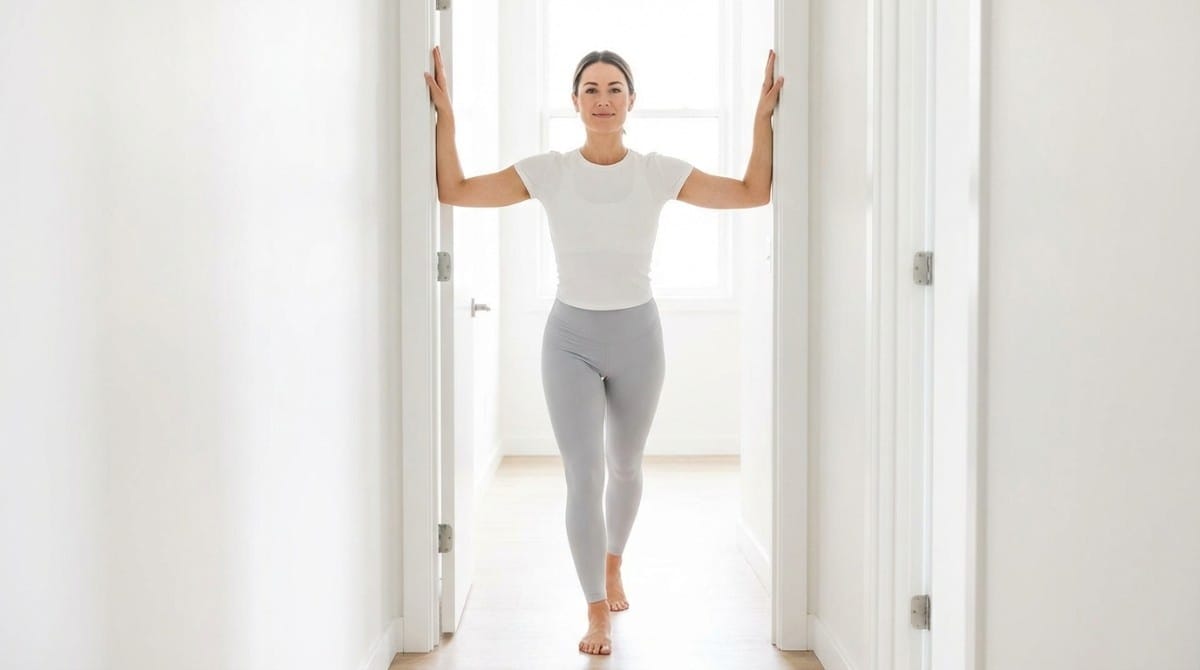
1. Doorway Chest Stretch Stand in a doorway. Place both forearms on the doorframe at 90 degrees. Step one foot forward and lean gently into the stretch until you feel an opening across your chest and the front of your shoulders. Keep your core lightly engaged so your lower back does not arch. Hold 30 seconds. Repeat twice.
Targets: Pectoralis major and minor, anterior deltoid.
2. Thoracic Extension Over a Foam Roller Place a foam roller horizontally under your upper back, at the level of your shoulder blades. Support your head with your hands. Gently let your upper back extend over the roller. Breathe in as you open. Hold 30--45 seconds. Shift the roller slightly upward and repeat for the next thoracic segment. Work 2--3 positions.
Targets: Thoracic spine mobility, anterior chest lengthening.
No foam roller? Use a rolled-up towel or the edge of a firm chair back.
3. Supine Cross-Body Arm Reach Lie on your back on the floor. Reach both arms out to your sides at shoulder height, palms facing the ceiling. Let gravity gently open your chest. Breathe slowly and deeply for 60 seconds. Focus on allowing your chest to rise and your shoulder blades to settle into the floor.
Targets: Pec minor, intercostal muscles, anterior shoulder.
Phase 2 - Activate (4 minutes)
Stretching alone does not fix posture. You must strengthen the muscles responsible for keeping your chest open throughout the day.
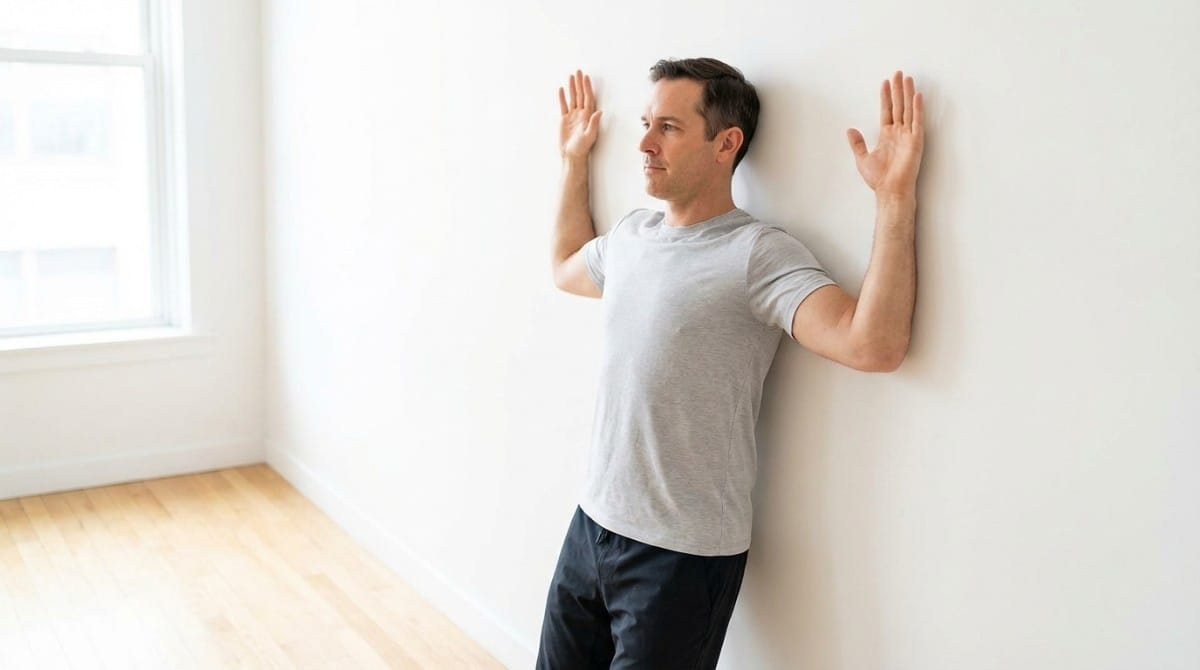
4. Wall Angels Stand with your back flat against a wall - head, upper back, and tailbone all in contact. Place your arms in a goalpost position (90 degrees at shoulder and elbow). Slowly slide your arms upward along the wall until they are fully extended overhead, then back down. Move only as far as you can keep everything in contact with the wall. 3 sets of 10 reps.
Targets: Lower and middle trapezius, rhomboids, serratus anterior. These are the key muscles that hold your chest open.
5. Scapular Retractions Sit or stand tall. Draw your shoulder blades directly together and slightly downward - as if trying to hold a pencil between them. Hold for 5 seconds. Release fully. Repeat 15 times. Focus on quality of contraction, not speed.
Targets: Rhomboids, middle trapezius. Directly counters rounded shoulders.
6. Band Pull-Apart (or Towel Pull-Apart) Hold a resistance band or folded towel at arm's length in front of you, hands shoulder-width apart. Pull the band outward and apart until your arms are fully extended to your sides and your shoulder blades squeeze together. Return slowly. 3 sets of 12 reps.
Targets: Posterior deltoid, rhomboids, mid-traps. Builds the pulling strength that keeps your chest naturally open.
Phase 3 - Integrate (3 minutes)
This phase locks in what you've just done by retraining your breathing and posture awareness.
7. Diaphragmatic Breathing Lie on your back or sit tall. Place one hand on your chest, one on your belly. Breathe in slowly through your nose for 4 counts - only your belly hand should rise. Hold 1 count. Exhale slowly for 6 counts. Repeat for 2 minutes.
This is not relaxation breathing. It is mechanical retraining. Shallow chest breathing is a key driver of persistent chest tightness - this corrects it.
Targets: Diaphragm activation, intercostal decompression, nervous system reset.
8. Chin Tuck with Neck Lengthening Sit or stand tall. Gently draw your chin straight backward - creating length through the back of your neck (not pressing down). Hold 5 seconds. Repeat 10 times. Finish with 3 slow neck rotations each direction.
Targets: Deep cervical flexors, forward head posture correction.
9. Posture Reset Stand Stand tall for 60 seconds. Feet hip-width apart. Soften your knees. Stack your hips over your ankles. Lift your chest without arching your lower back. Let your shoulders fall naturally back and down. Breathe normally. This is your target posture. Notice how it feels.
Posture Restoration: Quick Reference Table
What Happens If You Only Stretch and Never Strengthen?
This is the most common mistake. People stretch their chest daily, feel better for a few hours, then find their posture collapses again.
Stretching releases tension temporarily. But without the muscular endurance to hold your chest open, your body defaults back to its adapted short position within hours.
Physiotherapists often describe this as "stretching a rubber band without building the tension on the other end." The wall angels, scapular retractions, and pull-apart in Phase 2 are not optional additions - they are the part that makes the improvement permanent.
Research in musculoskeletal rehab consistently shows that posterior chain activation alongside anterior release produces significantly better and more durable postural outcomes than stretching alone.
How to Build This Into a Daily Habit
10 minutes is achievable. Here is how to make it automatic:
- Anchor it to something you already do. Right after your morning coffee. Right before your first work meeting. Immediately after lunch. Habit stacking makes new routines sticky.
- Keep your foam roller visible. If it is in a cupboard, you will not use it. Place it somewhere you see it every morning.
- Set a single daily reminder. Not multiple - one. Consistency is built by lowering friction, not adding pressure.
- Track your first 21 days. Early consistency is when the habit forms. After three weeks it becomes automatic.
When This Approach Doesn't Work
This routine is highly effective for most people with postural tightness and mild-to-moderate upper body pain. However, it has limits.
- Severe thoracic kyphosis (significant structural curvature) - requires supervised physiotherapy alongside home exercises
- Diagnosed herniated thoracic disc - unsupervised extension work can aggravate symptoms; get professional guidance first
- Chest pain that does not improve with movement - always rule out cardiac or respiratory causes with a doctor
- Shoulder impingement - wall angels and pull-apart may need modification; a physiotherapist can advise
- Scoliosis - asymmetric curvature requires a personalized program, not a bilateral routine
If you have tried a consistent routine for 4--6 weeks without improvement, a professional assessment is the right next step.
Research and Expert Insight
Musculoskeletal research supports the combined stretch-and-strengthen approach for postural correction. Studies examining upper crossed syndrome consistently find that isolated stretching produces temporary relief, while combined anterior release and posterior activation produces measurable, lasting improvement in alignment and pain scores.
Posture specialists emphasize the role of breathing in chest tightness resolution. Shallow chest breathing - a common adaptation in people with poor thoracic posture - creates chronic overuse of the scalene and upper trapezius muscles, maintaining the very tension the stretching is trying to release. Diaphragmatic retraining is not supplementary; it is mechanistically essential.
Research in mobility and flexibility science also supports brief, frequent sessions over infrequent longer ones. 10 minutes daily produces greater adaptive change than 70 minutes once a week - largely due to the role of consistent neurological re-patterning in postural habits.
Final Takeaway
Opening your chest and improving your posture is not complicated - but it does require doing the right things consistently. Release the tight front. Strengthen the weak back. Retrain your breathing. Do it daily.
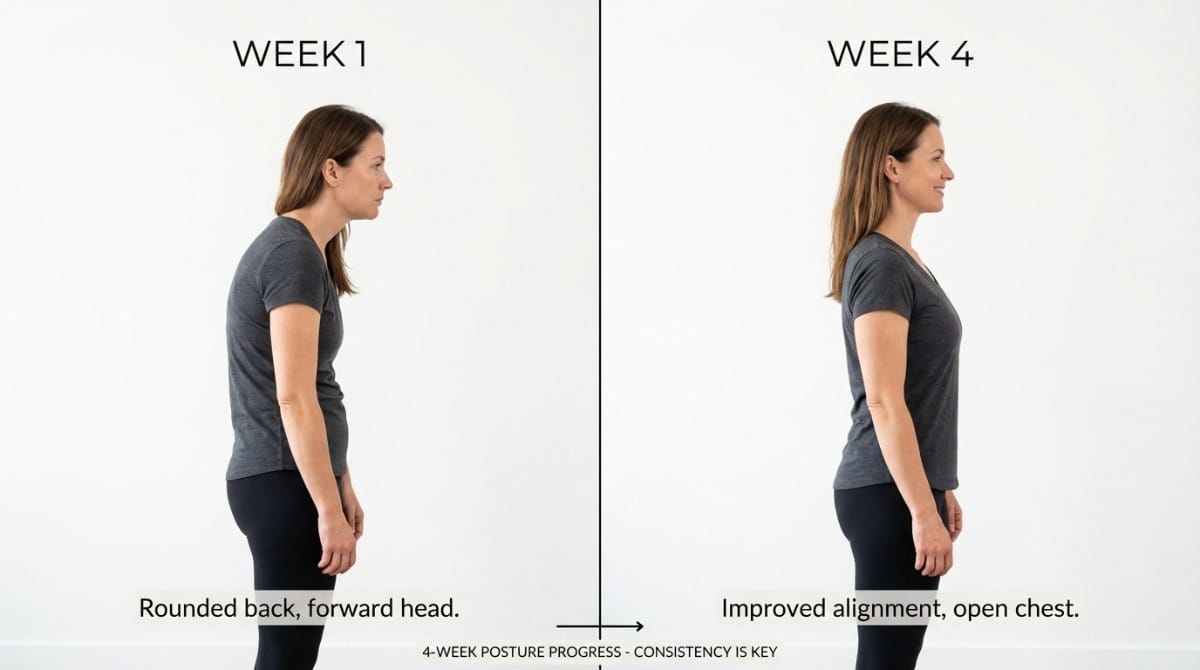
Ten minutes a day, done properly and regularly, is enough to reverse the postural adaptations that have built up over months or years of desk work. Most people notice meaningful change within 2-3 weeks. Significant structural improvement follows by weeks 6-8.
The routine works. Consistency is the only variable you control.
Why Most Chest-Opening Routines Fail After Two Weeks
Generic chest-opening routines are everywhere. YouTube has thousands of them. Most people try one for a week or two and quit - not because they are lazy, but because the routine was never built for them.
Four reasons generic plans fail:
- Wrong exercise selection - not everyone's chest tightness comes from the same imbalance pattern
- No progression - the same 9 exercises at the same intensity stop producing change
- No feedback - doing wall angels with your back arching off the wall eliminates most of the benefit without anyone telling you
- No accountability - without reminders and progress tracking, it is easy to drift back to old habits
Backed AI solves all four.
It uses your phone's camera to perform an AI posture analysis - identifying your specific pattern of tightness and weakness - and builds a personalized corrective program around your actual alignment, not a generic template.
Three things that make it different:
- 🎯 Personalized from day one - your routine is built around your specific imbalance pattern, not a one-size-fits-all sequence
- 📈 Progress tracking that adapts - as your posture improves, your program evolves with you
- 🔔 Daily habit reminders - the built-in consistency tools are what transform a good intention into a lasting result
If you are serious about opening your chest and standing taller, the difference between generic and personalized is the difference between short-term relief and permanent change.
Download Backed AI and start correcting your posture today. → backedapp.com
Frequently Asked Questions
Q1: Can you really improve posture in 10 minutes a day?
Yes - if the 10 minutes are structured correctly and done daily. Brief, frequent sessions produce better neurological re-patterning than infrequent longer ones. The key is combining anterior release with posterior strengthening and repeating it consistently.
Q2: What does "opening your chest" actually mean?
It refers to lengthening the shortened muscles across the front of your chest and shoulders while activating the weakened muscles across your upper back. Together, these changes restore your rib cage to a more open, naturally upright position.
Q3: Should I stretch my chest or strengthen my back first?
Stretch first, then strengthen. Releasing anterior tension before activating posterior muscles allows the strengthening work to be more effective. Doing it in reverse reduces the range of motion available for the activation exercises.
Q4: How long before I see results from chest-opening exercises?
Most people notice reduced tightness and improved breathing within 1-2 weeks. Visible postural improvement typically follows at 3-6 weeks of daily practice. Lasting structural change takes 8-12 weeks of consistent effort.
Q5: Why does my chest feel tight again after stretching?
Stretching alone does not fix posture. Without strengthening the posterior muscles (rhomboids, mid-traps, lower traps), your chest defaults back to its adapted short position within hours. Adding wall angels, scapular retractions, and pull-aparts to your routine is what makes the improvement stick.