15 Best Posture Exercises That Actually Work (Science-Backed + Practical)
Poor posture is one of the most common and correctable causes of back pain, neck tension, and reduced confidence. Targeted posture correction exercises can realign your spine, strengthen key support muscles, and reduce chronic discomfort - often within weeks of consistent practice.
TL;DR
- Poor posture is a muscle imbalance problem, not just a habit
- Stretching alone is not enough - you need strengthening too
- The most effective exercises target the thoracic spine, core, glutes, and hip flexors
- Consistency matters more than intensity
- Personalized programs outperform generic exercise lists for lasting results
Posture correction exercises are structured movements that retrain muscles, restore joint mobility, and rebuild the alignment patterns your body has lost through prolonged sitting, screen use, or physical imbalance.
What Is Poor Posture?
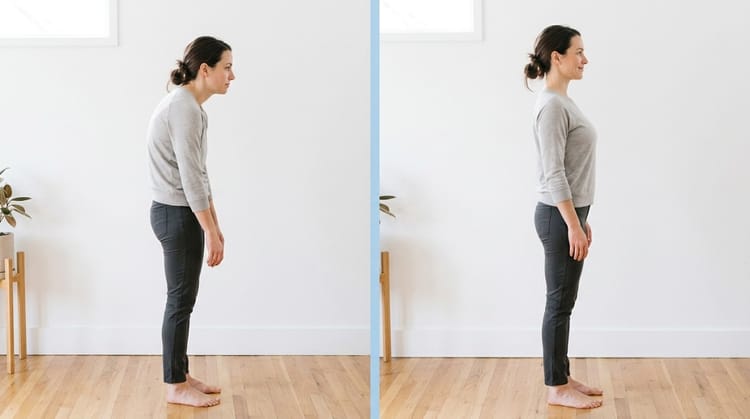
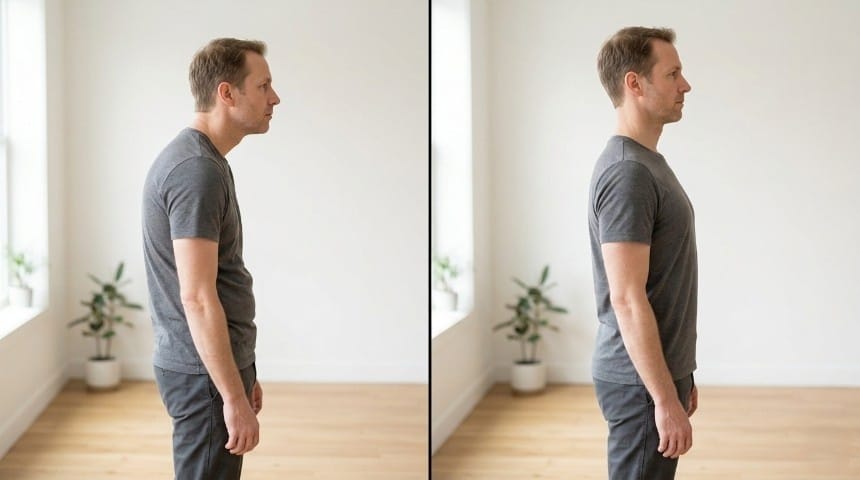
Poor posture is not simply "slouching." It is a pattern of musculoskeletal imbalance where certain muscles become overactive and tight while opposing muscles weaken and lengthen. Over time, this pulls joints out of their neutral position.
Common patterns include:
- Forward head posture – head sits ahead of the shoulders
- Rounded shoulders – chest caves inward, upper back rounds
- Anterior pelvic tilt – lower back arches excessively due to tight hip flexors
- Kyphosis (hunchback) – excessive thoracic spine curvature
These patterns often overlap. One imbalance tends to create another.
Why Does Poor Posture Cause Pain?
When your spine is out of alignment, surrounding muscles must compensate. Muscles that were not designed to hold your posture 24/7 become fatigued and inflamed. The result is persistent aching in the neck, upper back, lower back, and even headaches.
Posture specialists suggest that the average office worker holds a flexion-dominant position (hunched forward) for 6 to 9 hours daily. This chronically shortens the chest, hip flexors, and hamstrings while weakening the posterior chain - glutes, mid-back, and deep neck flexors.
Key Insight 💡: Posture correction is a two-part process. You need to release tight structures AND strengthen weak ones. Focusing on only one side of the equation leads to slow, incomplete results.
How Long Does It Take to Fix Posture?
Research in musculoskeletal rehab shows that meaningful postural changes can begin within 4 to 8 weeks of consistent, targeted exercise. Full correction of long-standing patterns may take 3 to 6 months. The key variable is consistency - not the difficulty of the exercises.
What Happens If You Ignore Poor Posture?
Left uncorrected, poor posture can progress from discomfort to chronic pain, nerve compression, reduced lung capacity, and restricted mobility. It also affects confidence and how others perceive you. Studies in body language research show that upright posture correlates with increased self-reported confidence and mood.
The Right Exercise Mix for Posture Correction
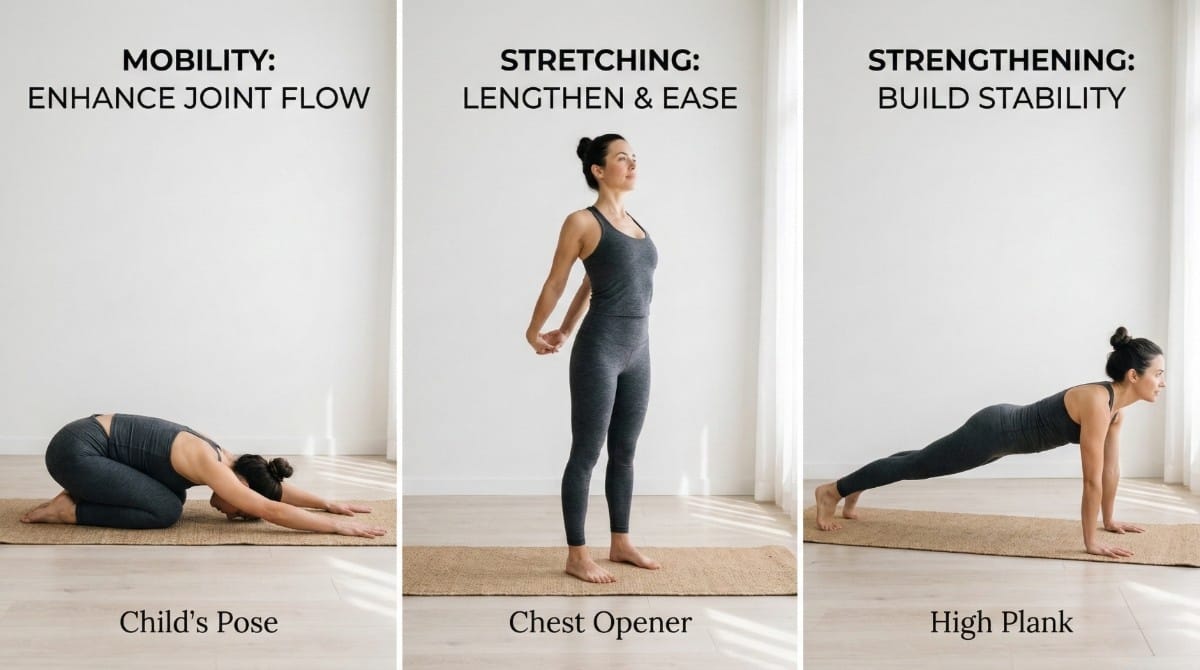
Effective posture correction requires three types of movement:
| Exercise Type | Purpose | Examples |
|---|---|---|
| Mobility work | Loosen tight muscles and joints | Cat-Cow, Thoracic rotation, Child's Pose |
| Stretching | Lengthen short, overactive muscles | Chest opener, Hip flexor stretch, Forward fold |
| Strengthening | Rebuild weak, underactive muscles | Plank, Glute bridge, Isometric pulls, Wall angels |
Physiotherapists often recommend combining all three in a single session rather than isolating one approach. A 15 to 20 minute routine is sufficient if exercises are well-chosen and performed correctly.
Best Exercises for Posture Correction (Quick List)
- Cat-Cow – Mobilises the entire spine and restores segmental movement. Ideal as a warm-up or morning reset.
- Child's Pose – Decompresses the lumbar spine and stretches the thoracic extensors. Holds tension release in the lower back and neck.
- Chest Opener – Counteracts the internal rotation caused by prolonged sitting and screen use. Opens the pec minor and anterior shoulder.
- Forward Fold – Releases hamstring and lower back tightness. Also decompresses spinal discs when held passively.
- Standing Cat-Cow – A functional version of the floor Cat-Cow, ideal for desk breaks or quick resets during the workday.
- High Plank – Builds full-body posterior chain engagement and core strength essential for sustained upright alignment.
- Side Plank – Strengthens the lateral stabilisers of the spine, preventing side-to-side sway and hip drop.
- Downward-Facing Dog – Combines hamstring stretch, shoulder mobility, and spinal decompression in a single movement.
- Pigeon Pose – Opens the hip rotators and iliopsoas, directly reducing anterior pelvic tilt.
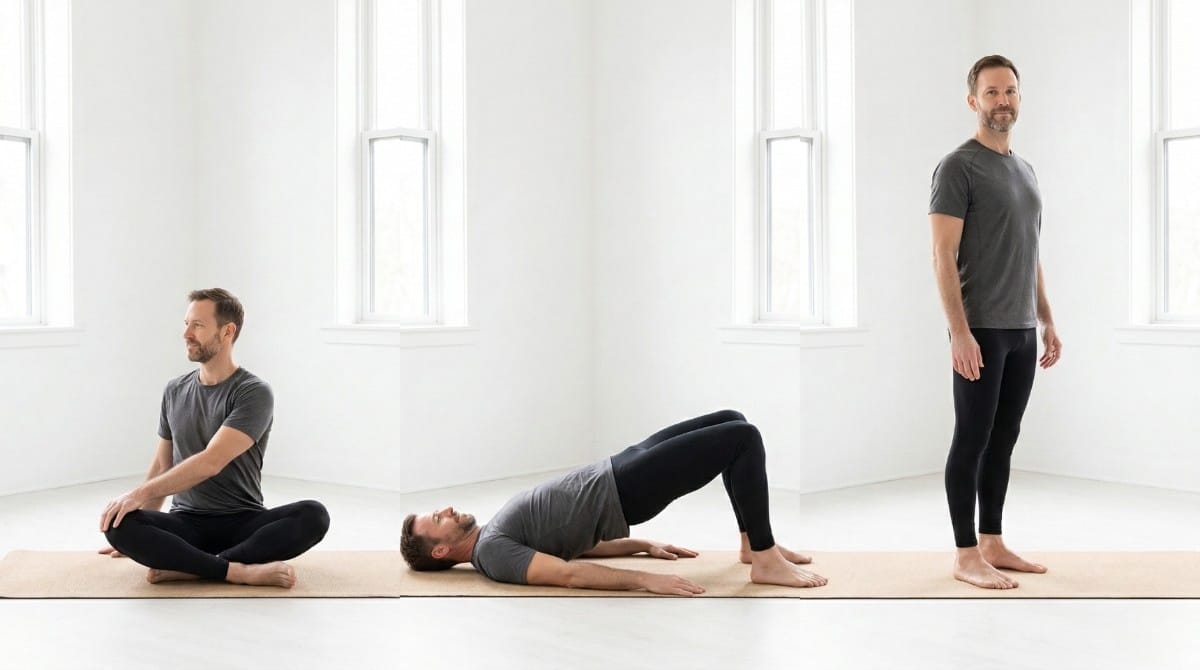
- Thoracic Spine Rotation – Restores mobility to the upper back, which tends to stiffen and round with desk work.
- Glute Bridge – Activates the glutes and posterior chain, reducing the hip flexor dominance that pulls the pelvis forward.
- Isometric Rows / Pulls – Strengthens the mid-back and retractors that hold the shoulder blades in correct position.
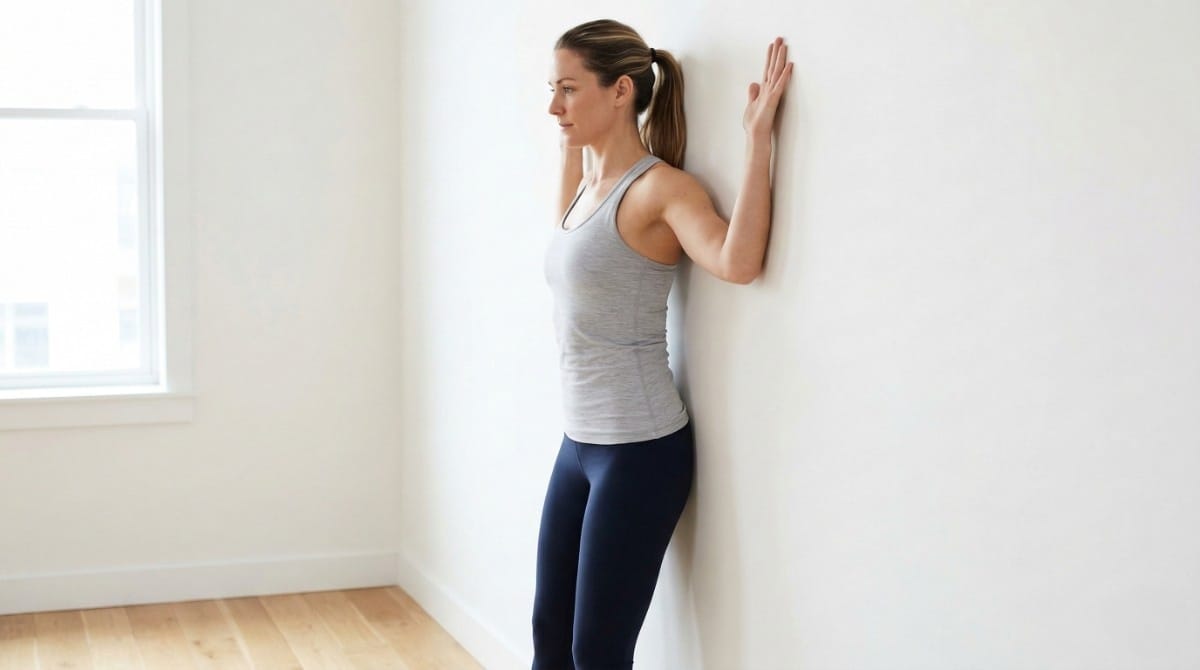
- Wall Angels – Trains shoulder blade movement against gravity, excellent for rounded shoulder correction.
- Dead Bug – Builds deep core stability without loading the spine, critical for lumbar posture control.
- Hip Flexor Lunge Stretch – Directly targets the psoas and rectus femoris, the most commonly shortened muscles in desk workers.
Step-by-Step Recovery Framework
Phase 1 – Weeks 1 to 2: Release and Mobilise
Focus on undoing the tightness before adding load. These exercises prepare the joints and muscles for strengthening.
Daily routine (10 minutes):
- Cat-Cow – 10 slow reps
- Child's Pose – hold 60 seconds
- Thoracic spine rotation – 8 reps each side
- Forward fold – hold 45 seconds
- Hip flexor lunge stretch – hold 30 seconds each side
Phase 2 – Weeks 3 to 5: Strengthen and Stabilize
Add the strengthening exercises. Maintain the mobility work as a warm-up.
Add to your routine:
- High plank – 3 x 30 to 45 seconds
- Glute bridge – 3 x 12 reps
- Isometric rows – 3 x 10 reps
- Side plank – 2 x 20 seconds each side
- Dead bug – 3 x 8 reps each side
Phase 3 – Weeks 6 onwards: Integrate and Progress
Combine movements, add challenge, and begin building posture into everyday activity. Increase plank holds, add resistance to bridges, and introduce wall angels.
Exercise Breakdown: Key Movements Explained
Cat-Cow
Cat-Cow restores movement to each vertebral segment of the spine. It is particularly valuable for people who sit for long periods, as it counteracts the static compression that builds up through the day.
How to do it:
- Start on all fours, wrists under shoulders, knees under hips
- Inhale and drop your belly toward the floor - lift your head and tailbone (Cow)
- Exhale and round your spine toward the ceiling - tuck chin and pelvis (Cat)
- Move slowly and breathe with each transition
- Repeat 10 to 15 times
Common mistake: Moving too fast and using momentum instead of controlled spinal segmentation.
Chest Opener
This stretch directly targets the pectoralis minor and anterior deltoid - the two structures most shortened by forward-leaning screen posture.
How to do it:
- Stand with feet hip-width apart
- Interlace fingers behind your lower back
- Keep your head level and gaze straight ahead
- Inhale and lift your chest while drawing hands toward the floor
- Hold for 5 breaths, release, repeat 10 times
Common mistake: Jutting the chin forward or arching the lower back excessively. Keep the ribcage neutral.
Glute Bridge
Weak glutes are a primary driver of anterior pelvic tilt and lower back pain. The glute bridge directly activates the posterior chain and teaches the hips to extend properly.
How to do it:
- Lie on your back, knees bent, feet flat on the floor hip-width apart
- Press both feet into the floor and exhale as you lift your hips
- Squeeze your glutes at the top - do not hyperextend the lower back
- Hold for 2 seconds, lower slowly
- Repeat 12 to 15 reps, 3 sets
Progression: Add a resistance band above the knees or move to single-leg variation.
Wall Angels
Wall angels are one of the most effective but underused exercises for rounded shoulder correction. They train the muscles responsible for shoulder blade retraction and upward rotation against gravity.
How to do it:
- Stand with your back flat against a wall
- Feet slightly away from the wall, lower back gently pressed back
- Raise arms to a "goalpost" position with elbows and wrists touching the wall
- Slowly slide arms overhead, keeping contact with the wall throughout
- Lower back to start position
- Repeat 10 reps
Common mistake: Allowing the lower back to arch away from the wall. Keep it lightly engaged throughout.
When This Approach Doesn't Work
Exercises alone will not resolve posture problems in every case. Consider seeking professional guidance if:
- Pain is sharp, radiating, or worsens with specific movements
- You have a diagnosed structural condition such as scoliosis or disc herniation
- You have completed 8 weeks of consistent exercise with no improvement
- Symptoms include numbness, tingling, or weakness in the arms or legs
Posture correction exercises are safe and effective for the majority of people with habitual postural imbalances. They are not a substitute for clinical assessment when symptoms suggest an underlying structural cause.
Research and Expert Insight
Posture correction is well-supported in rehabilitation science.
- Research in musculoskeletal rehab shows that exercise-based intervention significantly reduces pain and improves function in people with non-specific neck and back pain.
- Physiotherapists often recommend a combination of mobility and strengthening rather than stretching alone, as isolated stretching without concurrent strengthening leads to incomplete correction.
- Posture specialists suggest that motor learning - the process of retraining habitual movement patterns - takes 4 to 12 weeks of consistent repetition before new alignment becomes automatic.
- Studies in occupational health consistently identify prolonged sitting as the primary driver of flexion-dominant posture problems in working adults.

Lifestyle Integration Tips
Exercises are only part of posture correction. How you move through your day matters just as much.
- Set hourly reminders to stand, roll your shoulders back, and reset your alignment
- Adjust your workstation so your monitor is at eye level and your elbows rest at 90 degrees
- Walk more – walking activates the posterior chain and resets sitting compression
- Strengthen your core consistently – even 10 minutes of core work daily supports spinal stability
- Sleep position matters – side sleeping with a pillow between the knees maintains lumbar alignment overnight
Small, consistent habits compound. A well-designed posture correction routine practiced daily will produce results that sporadic intense sessions cannot match.
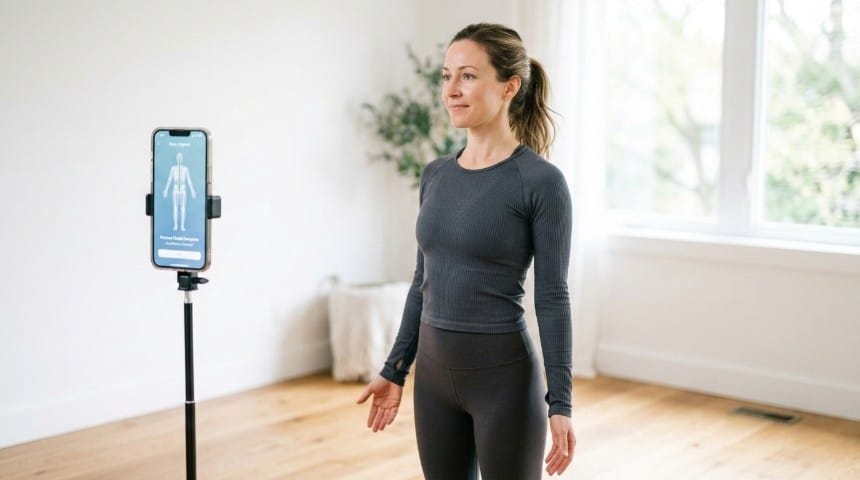
If you want to make this process faster and more accurate, Backed AI can scan your posture using your phone's camera and build a personalized correction program based on your specific imbalances. Instead of guessing which exercises apply to you, you get a plan built around your body. Try Backed AI free →
Final Takeaway
Poor posture is not a life sentence. It is a muscle imbalance pattern that responds well to targeted, consistent exercise. The most effective approach combines mobility work, strategic stretching, and posterior chain strengthening. Progression matters - start with gentle mobilisation, then build toward strength. The exercises in this guide are evidence-informed, practical, and scalable to any fitness level.
The missing ingredient for most people is not motivation - it is personalisation and accountability.
Why Most Exercise Plans Fail
Generic posture exercise lists fail most people for four reasons:
- Wrong exercises for your body. Forward head posture requires different work than anterior pelvic tilt. A list of 12 general exercises does not address your specific imbalance.
- No progression. Most lists give you exercises but not a structured path from beginner to corrected. Without progression, you plateau quickly.
- Inconsistency. Without reminders, habit tracking, or accountability, most people stop within 2 weeks.
- No form feedback. Doing the wrong form on a corrective exercise can reinforce the same imbalances you are trying to fix.
The Smarter Way to Correct Your Posture 📱
Backed AI is a posture correction app built around the problems that generic YouTube routines and exercise lists cannot solve.
Here is how it works differently:
- 🔍 AI posture scan – Point your phone camera at yourself. Backed AI analyses your alignment and identifies your specific imbalance pattern.
- 📋 Personalised exercise program – Instead of generic exercises, you receive a corrective routine built specifically for your posture profile.
- 📈 Smart progress tracking – Your improvements are tracked over time so you can see what is actually working and adjust accordingly.
Generic plans treat every body the same. Backed AI treats yours as the only one that matters.
Download Backed AI and start correcting your posture today. → backedapp.com
Frequently Asked Questions
Q1: How quickly can posture exercises improve my alignment? Most people notice reduced tension and improved awareness within 2 to 3 weeks. Visible postural changes typically emerge after 4 to 8 weeks of consistent daily practice.
Q2: How many times per week should I do posture correction exercises? Daily practice produces the best results for mobility and habit formation. Strength exercises can be done 3 to 5 times per week with rest days. Mobility and stretching work can be done every day safely.
Q3: Can you fix years of bad posture with exercise? Yes, for most people. Postural imbalances caused by prolonged sitting, screen use, and habitual patterns are muscular and neurological — not structural - and respond well to consistent corrective exercise. Structural conditions like scoliosis require clinical assessment.
Q4: What is the single best exercise for posture? There is no single best exercise because different imbalances require different corrections. However, the glute bridge and wall angels consistently appear in physiotherapy-recommended programs because they target the most commonly underactivated muscle groups.
Q5: Should I stretch or strengthen for posture? Both. Stretching releases tight muscles that are pulling your posture out of alignment. Strengthening builds the weak muscles that are unable to hold you upright. Doing only one without the other produces slow, incomplete results.