Best Posture Exercises for Desk Workers: A Complete 15-Minute Daily Routine
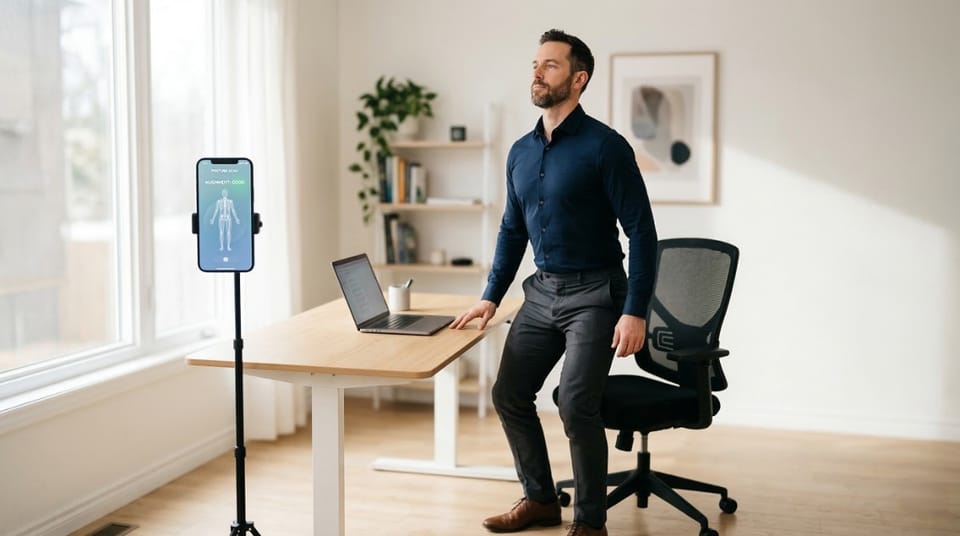
If you spend most of your day at a desk, your posture is quietly working against you. The chair, the screen, the keyboard - they all push your body into the same forward-flexed position for hours at a time. Over months and years, this reshapes how your muscles work, how your spine loads, and how much pain you carry.
The good news: a targeted 15-minute daily routine can undo most of this damage. You do not need a gym. You do not need equipment. You need the right exercises, in the right order, done consistently.
TL;DR
- Desk work creates a predictable set of muscle imbalances that exercises can reverse
- The most affected areas are the neck, upper back, chest, hip flexors, and core
- A 15-minute daily routine combining mobility, stretching, and light strengthening is enough
- Consistency every day beats longer sessions done occasionally
- Personalised programs outperform generic lists because desk workers have different imbalance profiles
Posture exercises for desk workers are targeted movements that counteract the specific muscle tightness and weakness patterns caused by prolonged sitting - restoring alignment, reducing pain, and rebuilding the strength needed to stay upright through a full workday.

What Does Desk Work Actually Do to Your Body?
Sitting at a desk is not a neutral activity. Every hour spent in a chair loads your body in a predictable pattern - and that pattern accumulates into real structural changes over time.
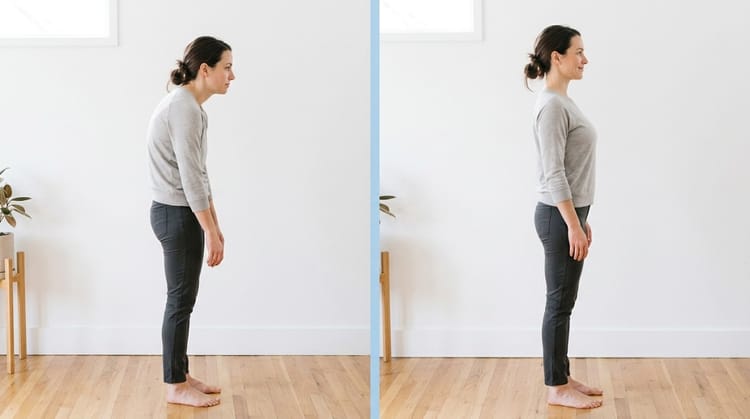
Desk work creates a musculoskeletal imbalance pattern where anterior (front-of-body) structures shorten and tighten while posterior (back-of-body) muscles weaken, lengthen, and lose their ability to maintain alignment.
Here is what happens across the major areas:
| Body Area | What Tightens | What Weakens |
|---|---|---|
| Neck | Suboccipital muscles, upper trapezius | Deep neck flexors |
| Upper back | Pectoralis minor, anterior deltoids | Rhomboids, mid and lower traps |
| Lower back | Thoracolumbar fascia, hip flexors | Glutes, core stabilisers |
| Hips | Psoas, rectus femoris, TFL | Glute medius, posterior hip rotators |
This pattern does not fix itself when you stand up. Once these changes are embedded, your body defaults to them even when you are off the clock.
Why Does Sitting Cause So Much Back Pain?
When the hip flexors shorten from hours of hip flexion, they pull the pelvis into an anterior tilt. This increases the lumbar curve, compresses the lower lumbar discs, and forces the lower back muscles to work overtime just to hold you upright. The result is the deep, dull ache that builds through the afternoon and is still there when you wake up.
Physiotherapists often point to hip flexor tightness combined with glute inhibition as the single most common driver of desk-related lower back pain - and it is almost entirely reversible with targeted exercise.
Why Does Neck Pain Start at the Desk?
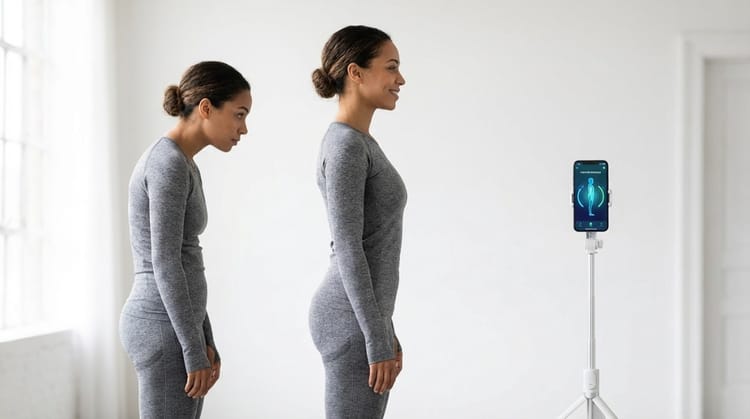
For every inch your head shifts forward from its neutral position, the effective load on your cervical spine increases by roughly 10 pounds. At a typical desk posture, the head is often 2 to 3 inches forward of neutral - meaning your neck muscles are managing the equivalent of a significantly heavier load all day. This creates the familiar tension headaches, neck stiffness, and shoulder tightness that most desk workers consider normal.
It is not normal. It is correctable.
What Happens If You Never Address It?
Posture specialists suggest that unaddressed desk posture imbalances tend to progress. What starts as afternoon stiffness can become chronic tension, nerve-related arm symptoms, persistent headaches, and reduced thoracic mobility that affects breathing and energy. The longer the patterns are left unaddressed, the more time and consistency correction requires.
Key Insight 💡: The office worker's body problem is not about weakness in isolation or tightness in isolation. It is a system of compensations. Fix one link in the chain and the others begin to respond.
15-Minute Desk Worker Posture Routine
This routine is structured in three phases: mobilise, stretch, strengthen. Each phase targets the specific areas most affected by desk work. The full sequence takes 15 minutes when done efficiently.
When to do it: First thing in the morning before you sit down, or at lunchtime as a midday reset. Either timing produces strong results. Morning practice is slightly preferable as it prepares the body before loading begins.
What you need: A yoga mat or clear floor space. No equipment required.
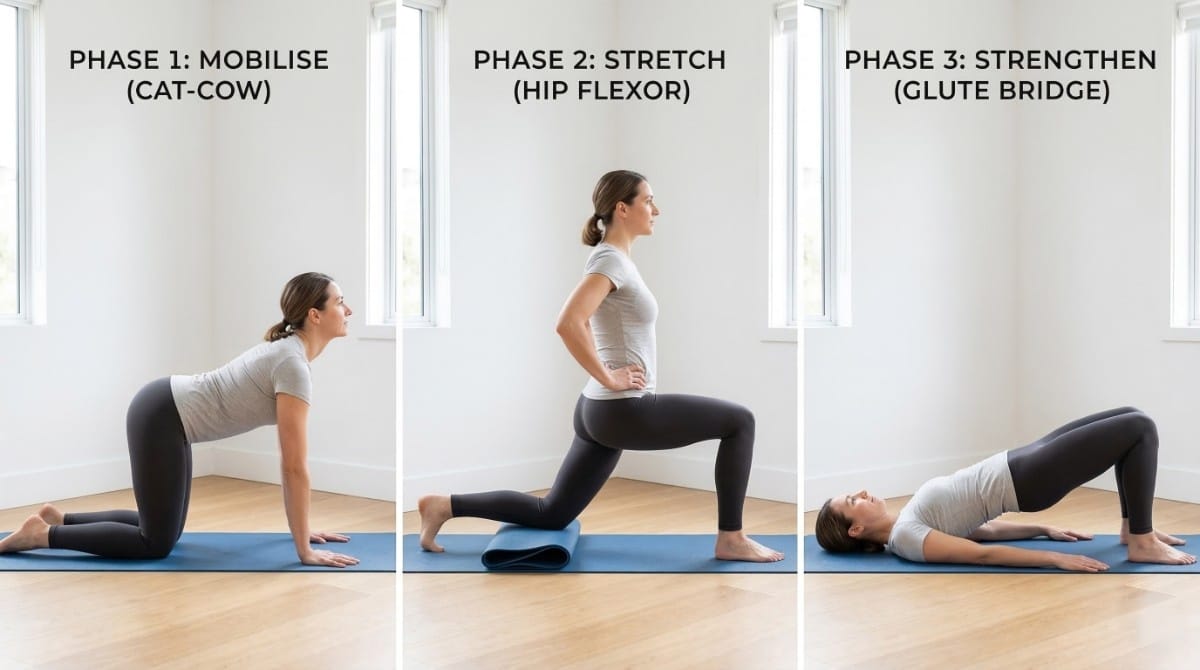
Phase 1 – Mobilise (4 Minutes)
These exercises restore movement to the joints that stiffen most from sitting. Do them slowly and with full breath control. The goal is circulation and joint mobility - not a workout.
1. Cat-Cow – 10 slow reps (90 seconds)
Restores segmental spinal movement from neck to pelvis. Counteracts the static compression that builds during prolonged sitting.
How to do it:
- Start on all fours - wrists under shoulders, knees under hips
- Inhale and drop your belly toward the floor, lift your head and tailbone (Cow position)
- Exhale and round your spine toward the ceiling, tuck chin and pelvis (Cat position)
- Move through the full range slowly, one breath per transition
- Repeat 10 times
Common mistake: Rushing the movement. The benefit comes from slow, controlled segmental movement - not speed.
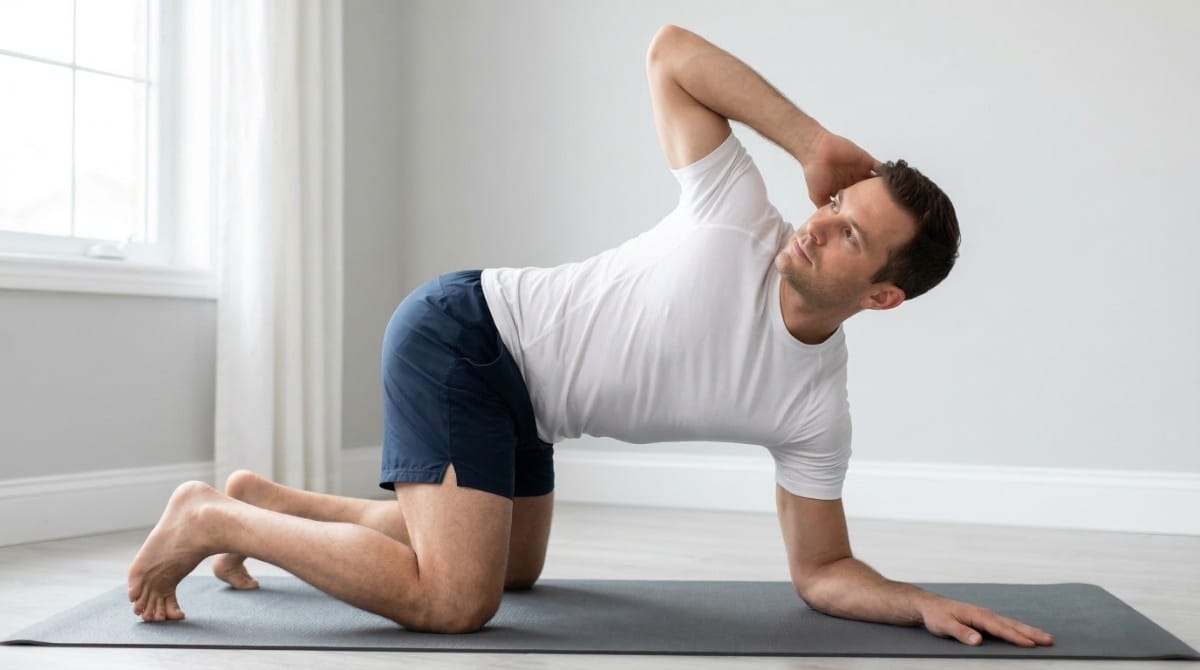
2. Thoracic Spine Rotation – 8 reps each side (2.5 minutes)
Opens the upper back, which locks up in a forward-flexed position through the workday. Directly targets the thoracic restriction that leads to neck pain and rounded shoulders.
How to do it:
- Come to all fours and sink hips back toward heels (child's pose base)
- Place one hand behind your head, elbow pointing out to the side
- Exhale and rotate that elbow up toward the ceiling, opening the front of your chest
- Hold for a breath at the top, then return slowly
- Complete 8 reps, then switch sides
Common mistake: Rotating from the lower back instead of the thoracic spine. Keep your hips anchored toward your heels throughout.
Phase 2 – Stretch (5 Minutes)
These stretches target the four tightest structures in desk workers: chest, hip flexors, hamstrings, and neck. Hold each for the prescribed time. Do not rush through them.
3. Chest Opener Stretch – 3 x 30 seconds
Directly reverses the internal shoulder rotation and chest shortening caused by keyboard and mouse use. One of the highest-impact stretches for desk workers.
How to do it:
- Stand with feet hip-width apart
- Interlace fingers behind your lower back, palms pressing together
- Keep your head level - do not jut the chin forward
- Inhale and lift your chest toward the ceiling, drawing hands gently toward the floor
- Hold for 30 seconds, breathe slowly, release and repeat twice more
Common mistake: Arching the lower back to create more chest lift. Keep the ribcage neutral and initiate the movement from the upper chest.
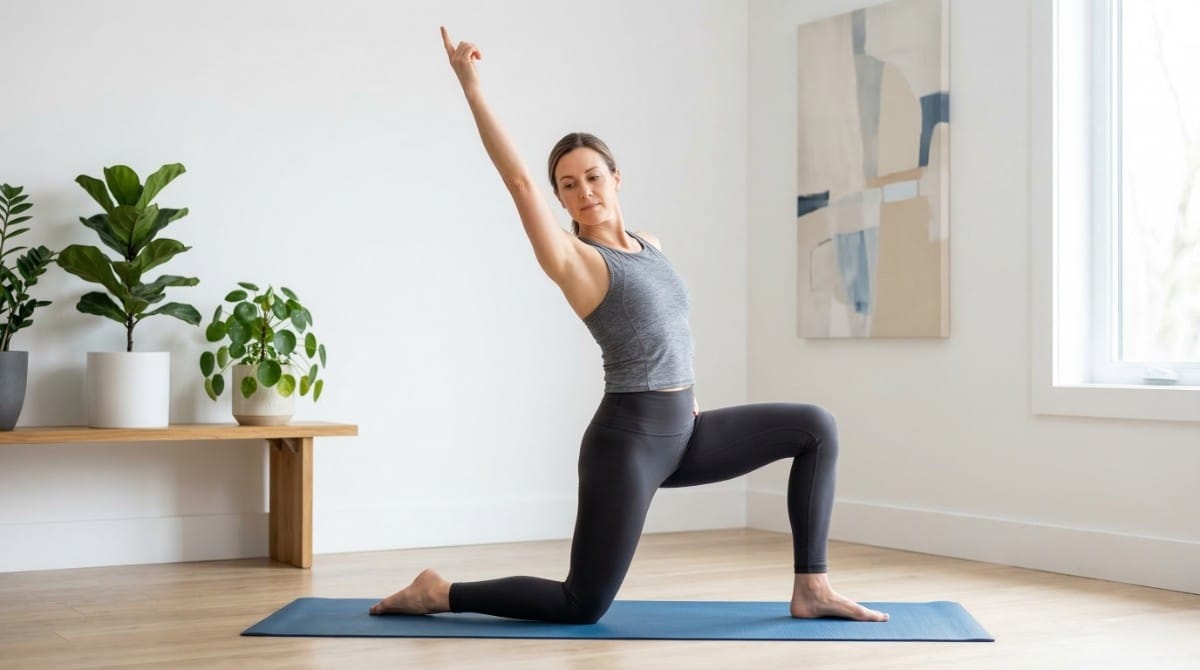
4. Hip Flexor Lunge Stretch – 45 seconds each side
The single most important stretch for desk-related lower back pain. The psoas and rectus femoris shorten severely with prolonged hip flexion and directly pull the pelvis into anterior tilt.
How to do it:
- Kneel on one knee in a lunge position - back knee on the floor, front foot flat
- Keep your torso upright and gently push your hips forward
- You should feel a deep stretch in the front of the back leg's hip
- To deepen: raise the same-side arm overhead and lean slightly away
- Hold 45 seconds, switch sides
Common mistake: Leaning the torso forward. Stay tall - the stretch comes from hip extension, not forward lean.
5. Doorway or Seated Neck Stretch - 30 seconds each side
Releases the upper trapezius and levator scapulae - the muscles that hold neck tension from forward head posture.
How to do it:
- Sit upright in a chair or stand
- Drop your right ear toward your right shoulder
- Place your right hand gently on the left side of your head for a light additional pull - do not force it
- Hold 30 seconds, breathe, switch sides
Common mistake: Raising the shoulder toward the ear instead of dropping the ear toward the shoulder. Let the shoulder stay down throughout.
Phase 3 – Strengthen (6 Minutes)
These exercises rebuild the muscles that desk work switches off. Weak glutes, a disengaged core, and inhibited mid-back retractors are the three core targets. You cannot stretch your way to good posture - these muscles must be rebuilt.
6. Glute Bridge – 3 x 12 reps
Reactivates the glutes, which become inhibited from prolonged sitting. Directly reduces the hip flexor dominance driving lower back pain and anterior pelvic tilt.
How to do it:
- Lie on your back, knees bent, feet flat on the floor hip-width apart
- Press both feet into the floor and exhale as you lift your hips toward the ceiling
- Squeeze your glutes firmly at the top - do not hyperextend the lower back
- Hold 2 seconds at the top, lower slowly over 3 seconds
- Complete 12 reps, rest 30 seconds, repeat for 3 sets
Progression: Add a resistance band above the knees or advance to a single-leg glute bridge.
7. Wall Angels – 2 x 10 reps
Trains the mid and lower trapezius and serratus anterior - the muscles responsible for holding your shoulder blades in correct position. Essential for rounded shoulder correction.
How to do it:
- Stand with your back flat against a wall - feet 6 inches from the baseboard
- Press your lower back, upper back, and head gently against the wall
- Raise arms to a "W" position with elbows and wrists touching the wall
- Slowly slide arms overhead into a "Y" position, keeping all contact points on the wall
- Lower back to the "W" position slowly
- Repeat 10 reps per set
Common mistake: Allowing the lower back to arch away from the wall as arms rise. Keep it engaged throughout.
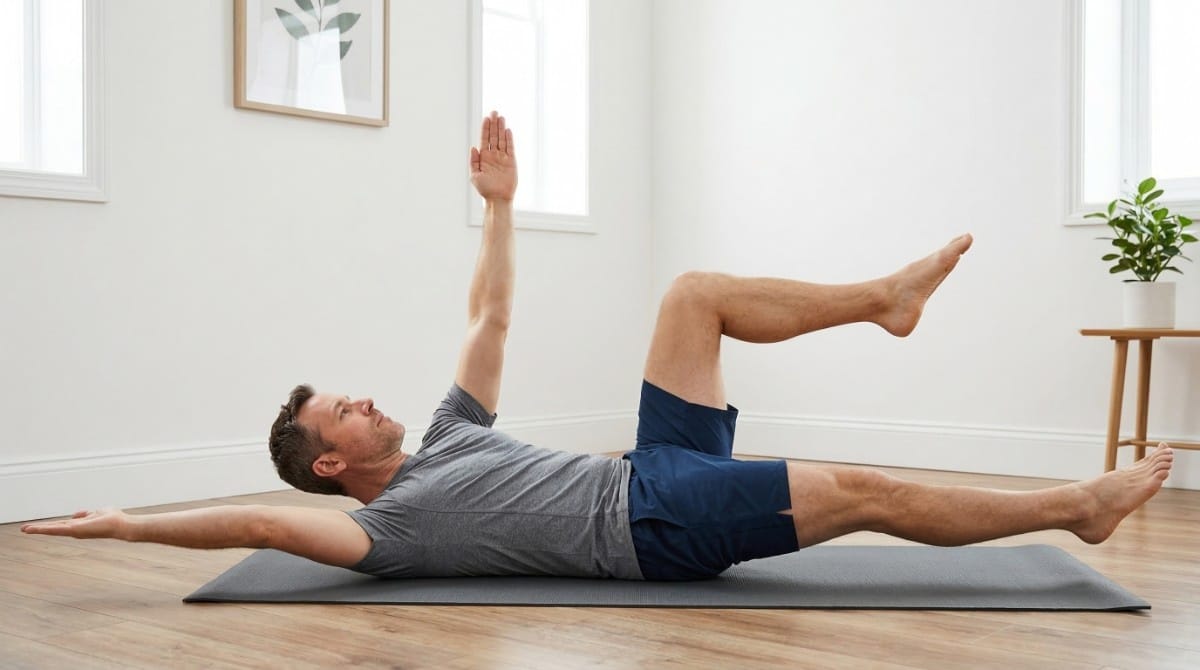
8. Dead Bug – 2 x 8 reps each side
Builds deep core stability - specifically the transversus abdominis without loading the spine. Desk workers lose core endurance faster than any other population due to the passive supported posture of sitting.
How to do it:
- Lie on your back with arms pointing straight up toward the ceiling
- Raise both legs to a 90-degree position - knees above hips, shins parallel to the floor
- Exhale and slowly lower your right arm back overhead while extending your left leg toward the floor
- Lower until both are hovering just above the ground - do not let your lower back arch
- Return to start, switch sides
- Complete 8 reps each side
Common mistake: Allowing the lower back to peel off the floor. If it does, reduce the range of movement.
9. Isometric Row (Seated or Standing) – 3 x 10 reps
Strengthens the mid-back retractors - rhomboids and mid trapezius - that hold the shoulder blades in a retracted position. Directly counteracts rounded shoulders.
How to do it:
- Sit upright in a chair with feet flat on the floor
- Make fists with both hands and extend arms forward at shoulder height
- Exhale and draw both elbows back strongly - squeezing shoulder blades together
- Hold the squeeze for 3 seconds
- Return slowly to the start position
- Repeat 10 reps for 3 sets
Common mistake: Shrugging the shoulders upward during the pull. Keep them down and focus the squeeze between the shoulder blades.
The Complete 15-Minute Routine at a Glance
| # | Exercise | Duration | Phase |
|---|---|---|---|
| 1 | Cat-Cow | 90 seconds | Mobilise |
| 2 | Thoracic Spine Rotation | 2.5 minutes | Mobilise |
| 3 | Chest Opener Stretch | 90 seconds | Stretch |
| 4 | Hip Flexor Lunge Stretch | 90 seconds each side | Stretch |
| 5 | Neck Side Stretch | 60 seconds each side | Stretch |
| 6 | Glute Bridge | 3 x 12 reps | Strengthen |
| 7 | Wall Angels | 2 x 10 reps | Strengthen |
| 8 | Dead Bug | 2 x 8 reps each side | Strengthen |
| 9 | Isometric Row | 3 x 10 reps | Strengthen |
Total: 15 minutes. Done daily, this routine addresses all the primary imbalance drivers of desk-related posture deterioration.
How to Build This Into Your Workday
The biggest obstacle to posture correction is not ability - it is consistency. Here is how to make this routine stick:
Morning anchor: Stack the routine directly after your morning coffee or before you open your laptop. Habit stacking onto an existing routine dramatically increases follow-through.
Desk break trigger: Set a phone alarm for lunchtime. Even if you skip the full routine, do Cat-Cow and the chest opener at your desk. Two minutes of targeted movement is far better than nothing.
Evening wind-down version: If mornings are tight, do the mobility and stretching components in the evening. Save the strengthening work for the morning when possible - it is more energising.
Progress check every 4 weeks: Notice how far you can open your chest in the chest opener. Notice whether your lower back lifts off the floor in dead bug. Notice whether your head reaches the wall in wall angels. These are your progress markers.
When This Approach Does Not Work
This routine is effective for the vast majority of desk workers with habitual posture imbalances. It will not resolve every case.
Seek professional guidance if:
- You experience sharp, stabbing, or radiating pain during any exercise
- Symptoms travel down your arm or leg (possible nerve involvement)
- You have a diagnosed disc herniation, scoliosis, or other structural condition
- You complete 8 weeks of consistent practice with no measurable improvement
- Morning stiffness lasts longer than 45 minutes (possible inflammatory cause)
Posture correction exercises are safe, effective, and low-risk for most adults. They are not a substitute for clinical assessment when symptoms suggest structural involvement.
Research and Expert Insight
The link between desk work and musculoskeletal pain is one of the most studied areas in occupational health.
- Research in occupational musculoskeletal medicine consistently identifies sedentary desk-based work as a primary driver of neck, shoulder, and lower back pain in working adults.
- Physiotherapists often recommend a combination of targeted stretching for anterior chain tightness and posterior chain strengthening as the most effective intervention for desk-related pain syndromes.
- Posture specialists suggest that short, frequent movement breaks provide more cumulative benefit than longer single exercise sessions - making a daily 15-minute routine more effective than a weekly 90-minute session for this population.
- Studies in workplace wellness programs show that structured daily exercise routines reduce reported back and neck pain complaints by a significant margin compared to general advice alone.
A structured, targeted approach consistently outperforms generic advice. Telling someone to "sit up straight" or "stretch more" without specificity produces minimal lasting change.
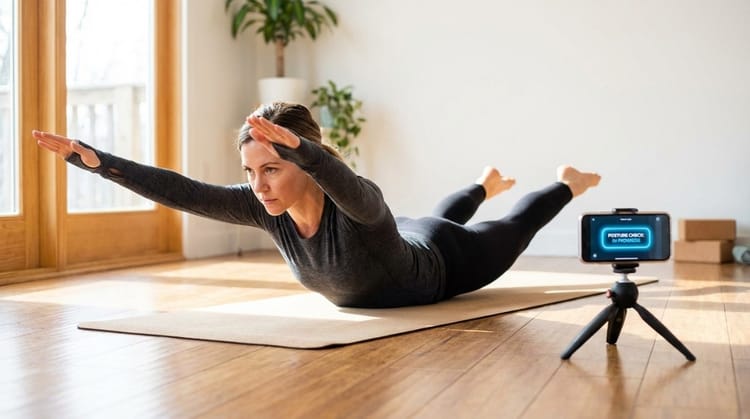
The exercises above are effective. But knowing which ones your body needs most - and in what order - makes all the difference. Backed AI uses your phone camera to scan your posture and builds a personalised correction program around your specific imbalance pattern. No guessing. Try Backed AI free →
Final Takeaway
Desk work creates a predictable set of muscle imbalances. Those imbalances are reversible. A well-structured 15-minute daily routine targeting the chest, hip flexors, neck, glutes, and mid-back can produce meaningful postural improvement within 4 to 8 weeks.
The key is structure and consistency - not intensity. You do not need to push hard. You need to show up daily, move through the right exercises in the right sequence, and give your body enough repetitions to rewire its default alignment.
Start with the mobility phase. Add the stretching. Build in the strengthening. Repeat daily. The results compound faster than most people expect.
Why Most Desk Worker Exercise Routines Fail
Generic desk worker exercise content fails for predictable reasons:
- No specificity to the individual. One desk worker has dominant forward head posture. Another has severe anterior pelvic tilt. A third has primarily rounded shoulders. All three need different exercise priorities - but most lists treat them identically.
- No progression built in. Starting Cat-Cow is easy. But what comes next? How does the program evolve? Without progression, results plateau within weeks.
- No accountability mechanism. Reading an article creates zero obligation to act on it. Most people perform the routine once or twice, then return to their habits.
- No form feedback. An isometric row done incorrectly can reinforce upper trap dominance rather than fix it. Form matters - and a list of instructions cannot provide real-time correction.
The Smarter Alternative for Desk Workers 📱
Backed AI was built specifically around the problems that generic exercise content cannot solve.
- 🔍 AI posture scan - Use your phone camera for a posture analysis that identifies your specific imbalance pattern - not a generic desk worker template.
- 📋 Personalised program - Receive a corrective exercise routine built around your body, your imbalances, and your schedule.
- 📈 Smart progress tracking - Track real postural improvement over time. See what is working. Adjust what is not.
Generic plans treat every desk worker the same. Backed AI treats yours as the only body that matters.
Download Backed AI and start correcting your posture today. → backedapp.com
Frequently Asked Questions
Q1: How often should desk workers do posture exercises? Daily practice produces the fastest and most lasting results. The routine is designed to take 15 minutes - short enough to maintain even on busy days. If daily is not achievable at first, aim for 5 days per week as a minimum.
Q2: Can posture exercises fix lower back pain from sitting? For most desk workers, yes. The majority of sitting-related lower back pain is driven by hip flexor tightness and glute inhibition - both of which respond well to the stretching and strengthening exercises in this routine. If pain is severe or radiating, seek clinical assessment before starting.
Q3: Is it better to exercise in the morning or during lunch for posture correction? Both are effective. Morning practice prepares the body before loading begins and benefits from habit consistency. Lunchtime practice breaks up prolonged sitting and provides a midday reset. Research in occupational health suggests that timing matters less than daily frequency.
Q4: How do I know if my posture is actually improving? Progress markers include: reduced afternoon neck and back tension, ability to hold wall angels with full wall contact more easily, less morning stiffness, and improved awareness of when you are drifting into poor alignment. Backed AI tracks these changes using posture scan data over time.
Q5: Are these exercises safe if I already have back pain? The mobility and stretching components of this routine are low-risk and appropriate for most people with general back discomfort. The strengthening exercises should be approached gradually. If any exercise increases pain rather than relieving it, stop and consult a physiotherapist.