Wall Angels for Desk Workers: The 5-Minute Posture Reset You Can Do at Your Desk
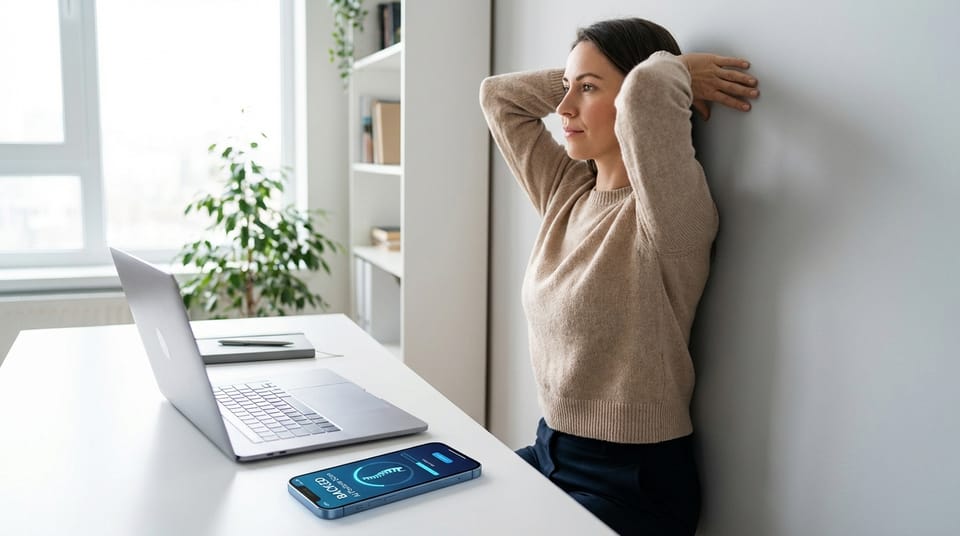
Wall angels take 5 minutes, require only a wall, and directly undo the postural damage caused by hours of sitting at a desk. For office workers dealing with a stiff upper back, tight neck, or creeping shoulder rounding, they are one of the most efficient corrective tools available - no gym, no equipment, no time lost.
Wall angels are a posture correction exercise where the spine is pressed flat against a wall and the arms slide through a V-to-W arc, actively retraining the upper back, shoulder stabilizers, and thoracic spine to hold better alignment.
TL;DR
- Desk work shortens your chest muscles and weakens your upper back - wall angels reverse both
- You can do them at your desk in under 5 minutes without changing clothes or leaving your workspace
- Correct form requires your head, spine, and arms to stay in contact with the wall throughout
- The most effective time to do them: mid-morning and mid-afternoon, when tension has built up
- 2 sets of 8-10 reps is enough for meaningful postural benefit
- Modifications exist if your shoulders are too tight for standard form
- Consistency - not volume - is what produces lasting change

Why Desk Work Destroys Your Posture
Most desk workers are not doing anything dramatic to their posture. The damage is slow and cumulative.
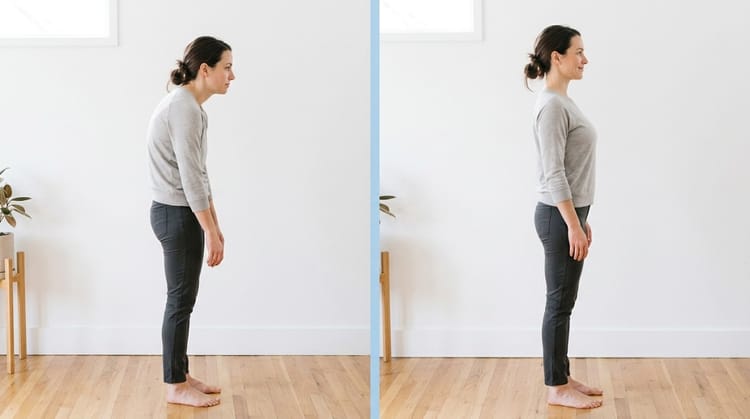
Sitting for 6-8 hours daily with your arms reaching forward toward a keyboard pulls your shoulders inward and forward. Your chest muscles (pectorals and anterior deltoids) shorten and tighten. Your upper back muscles - the rhomboids, lower trapezius, and serratus anterior - stretch out and weaken from being held in a lengthened position for too long.
Over weeks and months, your body adapts. The rounded position starts to feel normal. Muscles lose the ability to hold good alignment even when you try to sit up straight.
This pattern has a name: upper crossed syndrome - where tight chest and neck muscles cross over weakened deep neck flexors and upper back muscles.
The result is more than cosmetic:
- Persistent neck tension and headaches
- Tightness between the shoulder blades
- Upper back fatigue by mid-afternoon
- Reduced breathing depth from a compressed chest
- Lower energy and concentration as the day progresses
Wall angels directly address the muscle imbalances driving all of these symptoms.
What Wall Angels Do That Regular Stretching Cannot
Most desk workers stretch by rolling their neck or pulling one arm across their chest. These feel good in the moment. But they do not retrain muscle coordination or improve long-term alignment.
Wall angels do three things simultaneously:
- Strengthen the weakened muscles - rhomboids, lower traps, and rotator cuff are all activated during the movement
- Mobilize the thoracic spine - the wall contact encourages thoracic extension, the opposite of the desk-slump curve
- Retrain postural pattern - the wall acts as biofeedback, forcing your body to hold proper alignment while the arms move
This combination - strength, mobility, and pattern retraining in one exercise - is why physiotherapists consistently recommend wall angels for office workers over passive stretching alone.
💡 Key Insight: The wall is not just a prop. It is a real-time correction tool. Every rep where your back stays flat and your arms stay in contact with the wall is a rep that trains your nervous system to hold that position without the wall.

How to Do Wall Angels at Work (Step-by-Step)
You do not need a gym wall or special space. The wall behind your desk or a hallway wall works perfectly.
Step 1 - Find your wall Stand 6-8 inches away from any flat wall. Face outward, back toward the wall.
Step 2 - Press your back flat Press your lower back, mid-back, upper back, and head against the wall. All four contact points should touch. This is harder than it sounds if you have tight hip flexors or thoracic stiffness.
Step 3 - Engage your core Draw your belly button gently inward. This prevents your lower back from arching away as you move your arms.
Step 4 - Tuck your chin A gentle chin tuck - pulling your chin back toward the wall - gets your head into alignment. If your head does not comfortably reach the wall, place a small folded towel or jacket behind it.
Step 5 - Raise arms to V Extend both arms straight overhead, keeping the backs of your hands and elbows touching the wall. This is your starting position.
Step 6 - Slide down to W Slowly bend your elbows and slide your arms down the wall until your hands are just above shoulder height and your elbows form roughly 90-degree angles. Squeeze your shoulder blades together at the bottom.
Step 7 - Hold and return Hold the W position for 3-5 seconds. Feel the activation between your shoulder blades. Slide back up to V. That is one rep.
Repeat: 8-10 reps per set. 2 sets is the target. Rest 30-60 seconds between sets.
Total time: under 5 minutes.
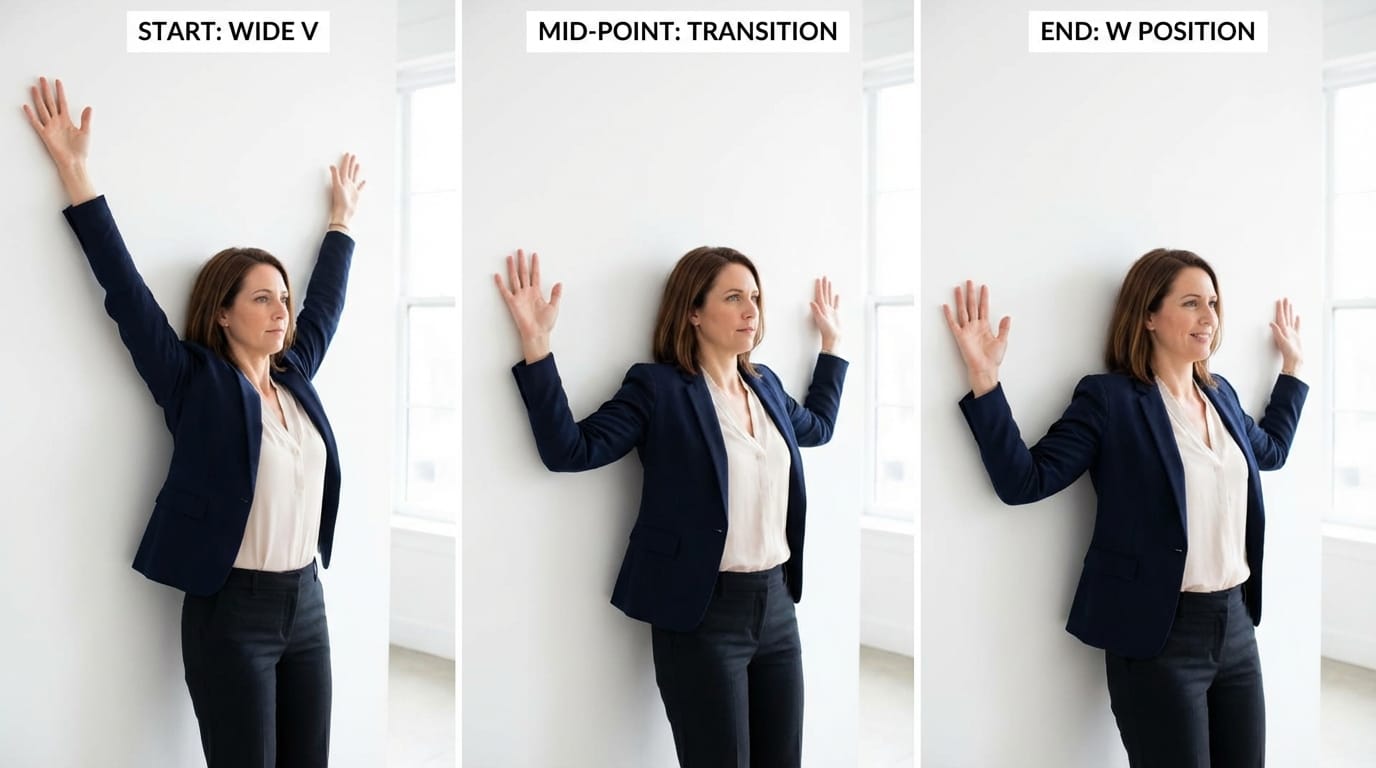
The Desk Worker's 5-Minute Wall Angel Routine
This is a structured reset you can repeat twice per day - no warm-up needed.
Why mid-morning and mid-afternoon? These are the points in the workday when postural fatigue has built up but the day is not yet over. A 5-minute reset at each of these windows reduces cumulative tension before it compounds into pain.
Wall Angel Modifications for Tight Desk Worker Shoulders
If you have been sitting for months or years with rounded shoulders, your chest and shoulder muscles will be tight. Standard wall angels may feel impossible at first.
Forward Wall Angel - Stand with arms slightly off the wall rather than pressed against it. Same movement, reduced demand. Progress toward full wall contact over 2-3 weeks.
Floor Angel - Lie on the floor with knees bent, lower back supported. Perform the same arm movement with backs of hands on the floor. Easier to maintain spinal alignment as a beginner.
Reduced Range of Motion - Do not try to reach full overhead V on day one. Start with arms at a 120-degree angle and increase range as flexibility improves.
Seated Wall Angel - Push your chair against the wall and perform the movement seated. Useful if standing for the exercise is uncomfortable or impractical.
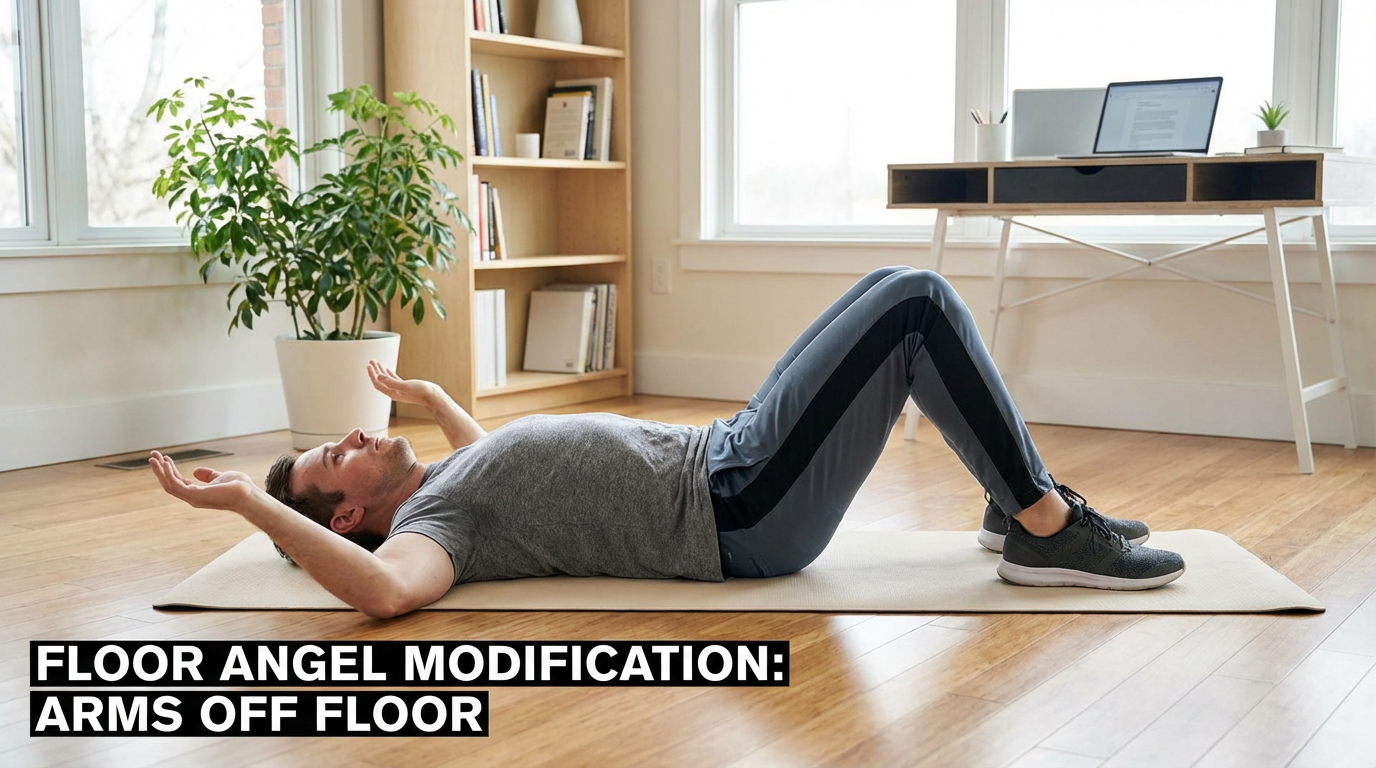
Why Does Tension Come Back Every Day?
This is the most common frustration for desk workers. You do your exercises. You feel better. You sit back down. The tension returns.
This is not a failure of the exercise. It is a timing and habit problem.
Wall angels create postural improvement by gradually retraining the muscles that hold your alignment. But this takes weeks of consistency - and the habits of sitting have to change alongside the exercises.
Three reasons desk worker tension keeps returning:
- Chair and monitor setup - If your screen is too low or your chair too high, your body will default to forward head posture regardless of how many wall angels you do
- No movement breaks - Sitting for 90 minutes without standing removes all the benefit of your morning exercise session
- Lack of progression - Doing the same 2 sets of wall angels indefinitely is not enough. The stimulus needs to evolve.
Wall angels are most effective when combined with regular movement breaks (every 45-60 minutes), basic ergonomic adjustments, and a progressive corrective exercise plan.
What Happens If You Do Wall Angels Every Day for 30 Days?
Research in musculoskeletal rehab shows that consistent upper back strengthening and thoracic mobility work produces measurable postural change within 4-8 weeks in sedentary adults.
For desk workers specifically, posture specialists suggest that daily corrective exercise targeted at scapular stabilizers reduces upper back fatigue, neck tension, and shoulder rounding - particularly when combined with movement breaks and ergonomic awareness.
What most people report after 30 days of daily wall angels:
- Less tension across the upper back and between the shoulder blades
- Reduced neck stiffness at the end of the workday
- Easier to sit upright without conscious effort
- Noticeable improvement in how far the arms can reach overhead
The change is not dramatic at 30 days. But it is real, measurable, and cumulative.
When Wall Angels Will Not Work for Desk Workers
Wall angels are effective for the vast majority of people with desk-related posture issues. But they have limits.
- If your workstation is poorly set up, the exercise will not overcome the structural cause of the problem. A monitor that is too low, a chair too high, or a keyboard too far forward will undo your correction daily
- If you only do them once or twice per week, the frequency is too low for meaningful change in a body that sits 8 hours daily
- If you have an underlying shoulder or cervical spine issue, wall angels may aggravate rather than help. Consult a physiotherapist before starting
- If the form is incorrect, you may be reinforcing compensation patterns rather than correcting them. Getting feedback on your form - especially in early weeks - makes a significant difference
Step-by-Step Recovery Framework for Desk Workers
Week 1-2: Learn the Pattern
- Use floor angel or forward wall angel modification
- Focus entirely on correct form - back flat, head contact, arm contact
- 2 sets of 8 reps, once daily
Week 3-4: Build the Habit
- Progress to standard wall angel
- Add second daily session (mid-afternoon)
- 2 sets of 10 reps, twice daily
Week 5-6: Add Complementary Work
- Pair with doorway chest stretch (2 x 30 seconds)
- Add chin tuck against wall (2 x 10 reps)
- Begin ergonomic review of workstation setup
Week 7-8: Assess and Progress
- Try the narrow wing variation for greater challenge
- Note changes in tension, posture, and shoulder mobility
- Consider a personalized AI posture scan to see measurable alignment change
Research and Expert Insight
Physiotherapists often recommend wall angels as a first-line corrective exercise for upper crossed syndrome in desk workers because they address all four key dysfunctions in a single movement: weak rhomboids, weak lower trapezius, tight pectorals, and impaired thoracic extension.
Research in occupational health consistently links prolonged sitting to increased cervical and thoracic musculoskeletal load. Studies show that even brief corrective exercise interventions during the workday - when performed consistently over 6-8 weeks - produce statistically significant reductions in self-reported neck and upper back pain in office workers.
Posture specialists note that the value of wall angels goes beyond the exercise itself: the wall biofeedback teaches the nervous system what neutral spine alignment feels like. Over time, the body begins to seek that position even without the wall present.
Final Takeaway
Wall angels are the most practical posture reset available to desk workers. They cost zero time, zero money, and zero equipment. Five minutes against the wall twice a day, done consistently over 4-8 weeks, is enough to reduce the upper back tension, shoulder rounding, and neck stiffness that desk work creates daily.
The exercise works. The challenge is building the habit - and knowing that your form is correct and your program is actually progressing.
Why Most Desk Worker Exercise Plans Fail
Desk workers trying to fix their posture face a specific problem. The cause of the issue - sitting - repeats itself 5 days a week, 8 hours a day. Generic exercise lists do not account for this.
Four reasons postural programs fail for office workers:
- No personalization: Your rounded shoulders, forward head tilt, and upper back stiffness are specific to your body and your habits. A generic program treats everyone the same
- No form feedback: Without knowing whether your wall angel form is correct, you may spend weeks reinforcing the wrong pattern
- No progression: Doing the same routine for months without increasing challenge means the body stops adapting
- No consistency system: Most people do their exercises for 2 weeks, stop, and wonder why nothing changed
Upgrade Your Posture Correction with Backed AI
Wall angels are a strong foundation. But lasting posture correction - especially for desk workers - requires knowing exactly what your body needs and following a program that evolves with you.
Backed AI scans your posture using your phone camera and builds a personalized corrective exercise plan based on your actual alignment. Not a template. Your program.
- 📱 AI posture scan - identifies your specific imbalances in under 60 seconds using your phone camera
- 🎯 Personalized exercise plan - wall angels, mobility work, and strength exercises matched to your posture pattern
- 📈 Progress tracking - measurable improvement data so you stay consistent and motivated through the weeks that matter
Desk workers who have been sitting for years need more than generic exercises. They need to know what is actually restricted in their body - and a plan that works around their schedule.
Download Backed AI and start correcting your posture today. → backedapp.com
FAQ
Q1: Can you do wall angels at work without looking awkward?
Yes. All you need is a wall - behind your desk, in a hallway, or in a bathroom. The movement takes under 5 minutes and requires no equipment or clothing change. Most people do them during coffee breaks.
Q2: How often should desk workers do wall angels?
Twice daily is the recommended starting point - once mid-morning and once mid-afternoon. This timing targets the points in the day when postural fatigue has built up the most.
Q3: Will wall angels fix my neck pain from sitting?
Wall angels strengthen the upper back muscles that support the neck and reduce forward head posture - a primary driver of desk-related neck pain. Most people notice reduced neck tension within 2-3 weeks of consistent daily practice.
Q4: Do I need to combine wall angels with other exercises?
Wall angels are effective alone. They become significantly more effective when paired with a doorway chest stretch (to release tightened pectoral muscles) and a chin tuck exercise (to address forward head posture directly).
Q5: What if I cannot keep my lower back against the wall during wall angels? T
his is extremely common in desk workers due to tight hip flexors. Try standing with your feet slightly further from the wall, engaging your core before each rep, or using the floor angel modification until your flexibility improves.