Rounded Shoulders and Forward Head Posture: Why They Happen Together and How to Fix Both
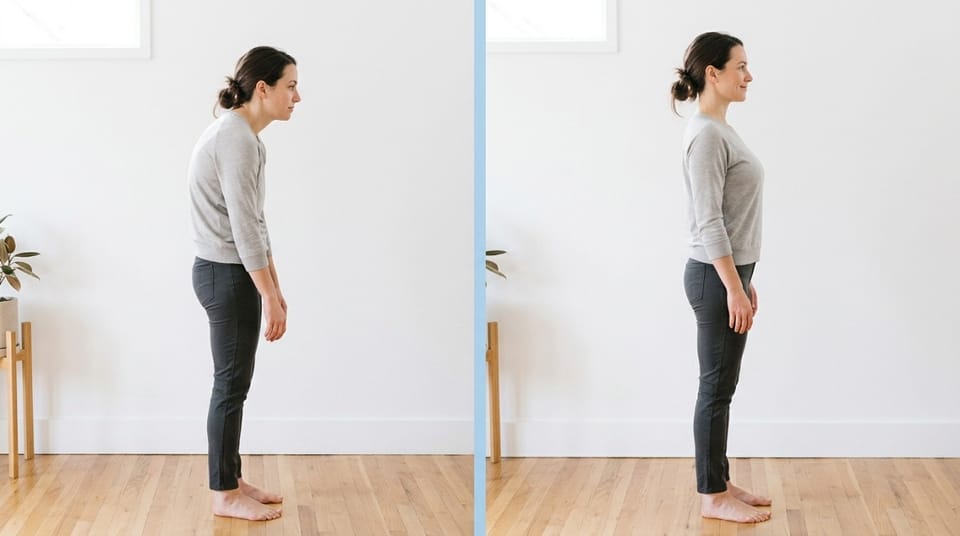
Rounded shoulders and forward head posture almost always occur together - and treating them separately is one of the main reasons people fail to see lasting improvement. These two conditions share the same root cause and require a coordinated correction approach, not two separate exercise lists.
Rounded shoulders and forward head posture are a linked postural syndrome where the upper spine collapses forward, the chest closes, the shoulder blades flare outward, and the head drifts in front of the body's center of gravity.
Fix one without addressing the other and you are solving half the problem.
TL;DR
- Rounded shoulders and forward head posture almost always occur together as part of the same postural pattern
- Both conditions are caused by the same muscle imbalances - weak upper back, tight chest and neck flexors
- Correcting them requires a specific sequence: release tight muscles first, then strengthen weak ones
- The most effective exercises target the rhomboids, deep neck flexors, trapezius, and thoracic extensors
- Generic exercise lists often fail because they address one condition at a time - not the combined pattern
- A personalized, sequenced plan produces faster and more lasting results
What Is the Rounded Shoulders and Forward Head Posture Pattern?
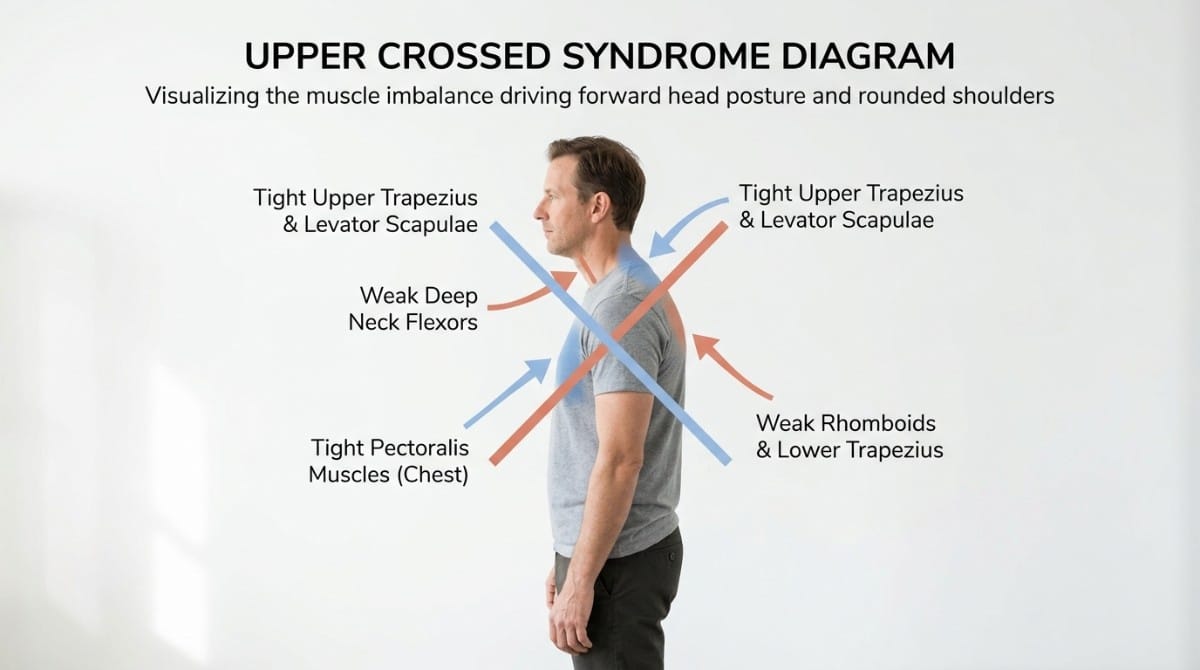
These two conditions are part of what posture specialists call upper crossed syndrome - a predictable pattern of muscle tightness and weakness that develops from prolonged sitting, screen use, and sedentary habits.
Here is what is happening in the body:
Tight and overactive:
- Chest muscles (pectoralis major and minor)
- Upper trapezius
- Neck flexors (sternocleidomastoid, scalenus)
- Suboccipital muscles at the base of the skull
Weak and underactive:
- Rhomboids and mid-trapezius
- Deep neck flexors (longus colli, longus capitis)
- Lower trapezius
- Serratus anterior
The tight muscles pull everything forward. The weak muscles can no longer resist. The result is a forward-collapsed posture that becomes harder to hold upright the longer it persists.
Why Do Rounded Shoulders and Forward Head Posture Happen at the Same Time?
Because they share the same mechanical trigger.
When the thoracic spine (mid-back) rounds forward, the head must travel with it to keep the eyes level with the horizon. The brain prioritises keeping the gaze horizontal - so as the upper back collapses, the neck compensates by extending forward.
This is not a choice. It is a structural reflex.
The result: for every inch the head shifts forward, the effective load on the cervical spine increases significantly. The neck muscles work harder and harder to hold the head up. The shoulders roll inward as the chest tightens and closes.
Both conditions accelerate each other. That is why desk workers with rounded shoulders almost universally also develop forward head posture - and why treating only one rarely produces full correction.
💡 Key Insight: Physiotherapists often address the thoracic spine first when treating this combined pattern - because restoring mid-back extension naturally pulls the head back and opens the shoulders, making the remaining corrections easier and faster.
How to Tell If You Have Both Conditions
You do not need a clinical assessment to recognize the pattern. A simple wall test reveals both:
- Stand with your back against a wall, heels about 5 cm from the base
- Press your lower back gently to the wall
- Try to bring the back of your head to the wall without tilting your chin up
If your head cannot reach the wall comfortably, you have measurable forward head posture.
If your shoulders do not touch the wall, or there is a significant gap at the upper back, rounded shoulders are contributing.
Most people with desk jobs will find both are present to some degree. This is extremely common - and correctable.
For a deeper look at how these posture patterns develop day to day, this guide to types of bad posture explains the broader spectrum worth reviewing.
The Correction Sequence: What to Fix First and Why
This is the element most generic exercise lists miss entirely.
You cannot effectively strengthen weak muscles while the opposing tight muscles are dominating the movement. Trying to retract the shoulder blades when the chest is locked tight is like trying to open a door while someone pushes it shut from the other side.
The correct sequence is:
Step 1: Release tight muscles first Target the chest, upper traps, and neck flexors before any strengthening work.
Step 2: Activate the underused muscles Begin with low-load activation exercises for the rhomboids and deep neck flexors.
Step 3: Strengthen through the full pattern Progress to compound movements that train the upper back, thoracic extensors, and posterior shoulder together.
Step 4: Integrate into daily posture habits Translate strength gains into awareness and alignment during sitting, standing, and movement.
Skipping Step 1 is the most common mistake. If you start with rows and scapular retraction exercises without releasing the chest first, you will find the movements feel restricted and gains plateau early.
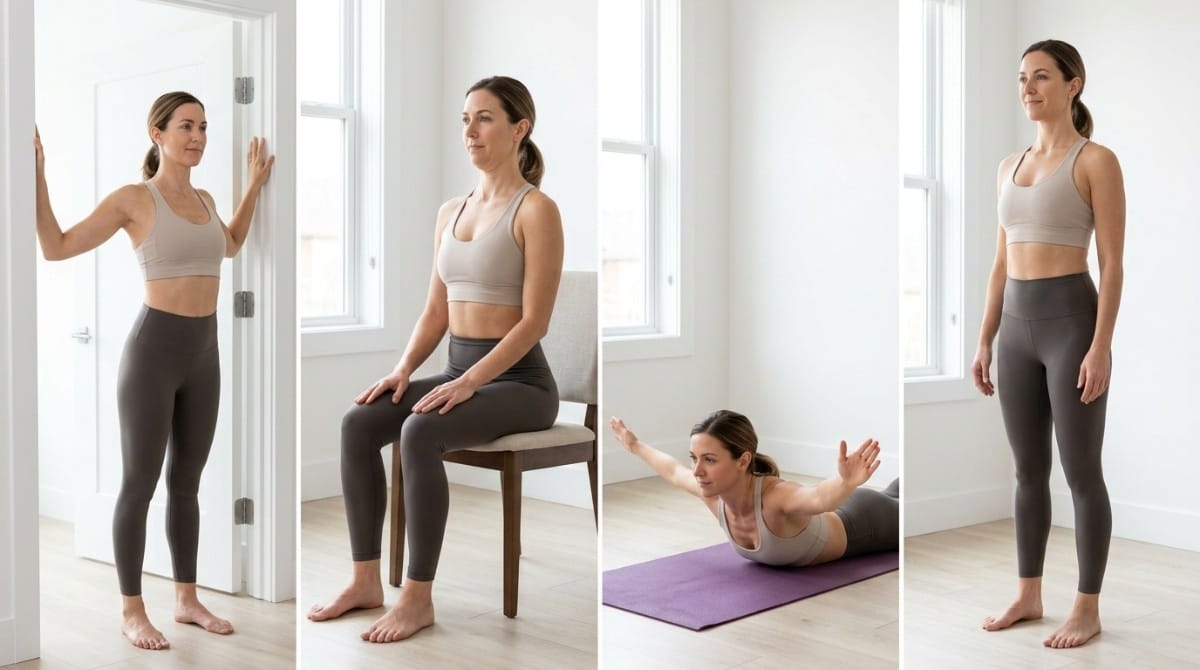
Best Exercises for Rounded Shoulders and Forward Head Posture (Quick List)
These exercises follow the release-activate-strengthen sequence. Work through them in order for best results.
PHASE 1 - RELEASE
1. Doorframe Chest Stretch Opens the pectoralis minor and major, which are the primary drivers of shoulder rounding. Stand in a doorway, place forearms on the frame, and gently lean forward. Hold 30 seconds, 3 times. Do not force the stretch.
2. Upper Trap Stretch Releases the neck-to-shoulder tension that contributes to forward head position. Sit tall, tilt your ear toward your shoulder, and hold for 20-30 seconds each side.
3. Suboccipital Release Place two tennis balls or a rolled towel at the base of the skull while lying on your back. Rest your head on the balls for 2-3 minutes. This releases the tight muscles that pull the skull backward and compress the cervical spine.
PHASE 2 - ACTIVATE
4. Chin Tuck The most direct corrective exercise for forward head posture. Stand or sit tall and gently draw the chin straight back - not down. Hold 5 seconds. Repeat 10-15 times. This reactivates the deep neck flexors. Forward head posture exercises has a full breakdown of this movement and its progressions.
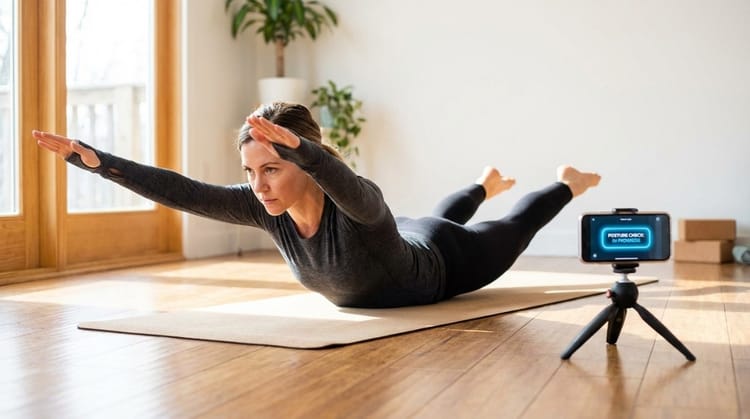
5. Prone Y-Raise Lie face down on a mat, arms extended in a Y shape. Lift both arms off the floor while squeezing the shoulder blades together and downward. This activates the lower trapezius - the key stabilizer for correcting shoulder rounding. 3 sets of 12 reps.
6. Wall Slide Stand with your back against the wall and raise your arms into a W position, elbows bent. Slowly slide arms up the wall to a Y and back down. Trains scapular upward rotation and breaks the rounded-shoulder movement pattern. 3 sets of 10 reps.
PHASE 3 - STRENGTHEN
7. Prone Pull (Bodyweight Row) Lie face down, arms extended, then draw both elbows back toward your lower back while squeezing the shoulder blades together. Builds rhomboid and mid-trap strength. 3 sets of 12 reps.
8. Scapular Push-Up (Reverse) In a prone position, retract the shoulder blades first, then perform a push-up motion. The scapular movement is the priority, not the push itself. Trains the serratus anterior and lower traps simultaneously.
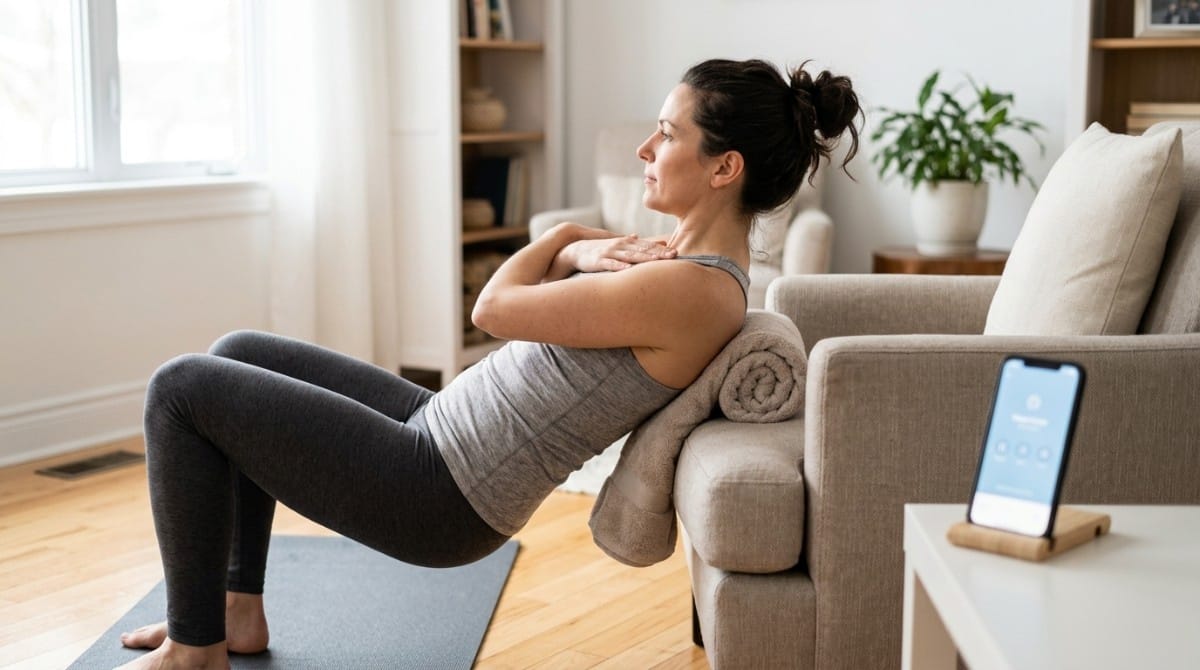
9. Thoracic Extension Over a Foam Roller or Chair Back Sit in a chair and place a rolled towel or firm cushion at the mid-back level. Extend gently backward over it, arms crossed on the chest. Holds 20-30 seconds. This directly addresses thoracic kyphosis - the root of the whole pattern.
For a full structured programs specifically targeting rounded shoulders, the complete rounded shoulders guide covers causes, progressions, and lifestyle corrections in depth.
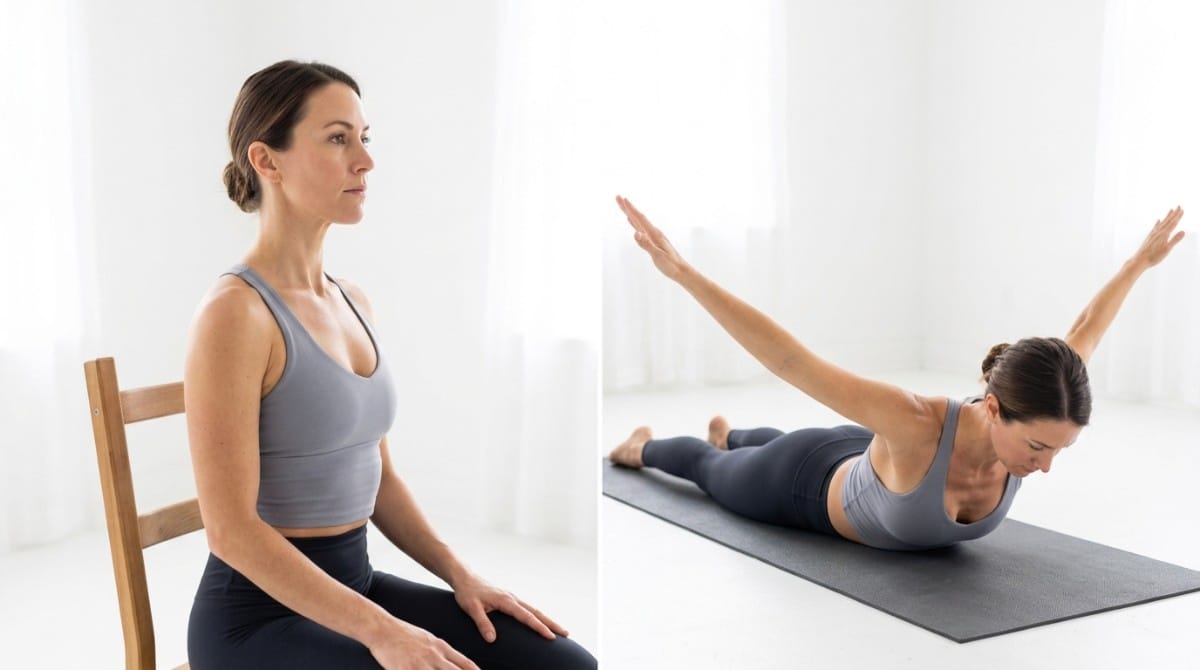
Bodyweight Exercises vs. Targeted Correction: A Comparison
The sequenced approach takes more effort to design - but it produces results that actually hold.
Research & Expert Insight 🔬
Research in musculoskeletal rehabilitation consistently shows that upper crossed syndrome responds well to combined stretching and strengthening protocols when exercises are sequenced correctly.
Posture specialists suggest that thoracic extension exercises are the single most underused intervention in self-directed posture correction. Most people focus on stretching the chest and strengthening the back - but without restoring thoracic mobility first, neither intervention reaches its potential.
Studies in occupational health have found that desk workers who perform targeted scapular stabilization and deep neck flexor exercises report measurable reductions in neck and upper back pain within 4-6 weeks of consistent practice.
Physiotherapists often recommend the chin tuck as the highest-value single exercise for forward head posture because it simultaneously stretches the suboccipital extensors and strengthens the deep cervical flexors - addressing both the tight and weak sides of the pattern in one movement.
When This Approach Doesn't Work
The release-activate-strengthen sequence works for the vast majority of people with posture-related forward head posture and rounded shoulders. But there are situations where it needs adjustment.
Seek professional assessment if:
- Neck pain radiates into the arm or causes numbness or tingling
- Symptoms worsen after exercise rather than improving
- You have a diagnosed disc issue or previous cervical spine injury
- Headaches are frequent and severe - not just tension-based
The approach may plateau if:
- You skip the release phase and go straight to strengthening
- You do the exercises without any awareness of your posture between sessions
- You perform strengthening exercises with poor form - common without any feedback system
This is the critical gap in self-directed correction. You can follow the right exercises and still see slow progress if your form is off or your sequencing is wrong.
For desk workers specifically, this 15-minute daily posture routine integrates many of these principles into a time-efficient format designed around work schedules.
Step-by-Step Weekly Recovery Framework
Days 1, 3, 5 - Full Sequence (20-25 minutes)
- Phase 1 release (chest stretch, upper trap stretch, suboccipital release): 5 minutes
- Phase 2 activation (chin tucks, prone Y-raise, wall slides): 3 sets each
- Phase 3 strengthening (prone pull, scapular push-up, thoracic extension): 3 sets each
Days 2, 4 - Active Recovery (10 minutes)
- Light thoracic mobility: foam roller extension, cat-cow, arm circles
- Chin tuck repetitions: 2 sets of 15
- Standing posture awareness check using the wall test
Daily habit (2 minutes):
- Wall test each morning to track progress
- Chin tuck set at your desk mid-afternoon
- Doorframe chest stretch before bed
Weeks 1-2: Focus on form and the release phase. Expect initial relief in neck and upper back tension. Weeks 3-4: Add strengthening volume. Begin to notice postural awareness improving during the day. Weeks 5-8: Consolidate. Strength gains make neutral posture feel more effortless and sustainable.
Final Takeaway
Rounded shoulders and forward head posture are not two separate problems. They are one connected pattern that requires one connected solution.
The key principles:
- Address the release phase before strengthening - this is non-negotiable
- Target both conditions simultaneously, not sequentially
- Follow the correct exercise order: release, activate, strengthen, integrate
- Consistency over 6-8 weeks produces real postural change
- Form quality matters more than exercise volume
Start with the chin tuck and the doorframe chest stretch. Build from there. Small consistent actions compound into visible, lasting results.
Why Most Exercise Plans for This Pattern Fail
Most people who try to fix rounded shoulders and forward head posture do the right exercises in the wrong order - or skip the release phase entirely.
Generic exercise plans fail because:
- They list movements without explaining the sequence or why it matters
- There is no form feedback - you cannot tell if your chin tuck is correct or if you are compensating
- There is no progression built in - the same exercises at the same intensity stop producing results after a few weeks
- Nothing tracks whether your posture is actually improving between sessions
The result is weeks of effort with frustrating, inconsistent improvement.
A Smarter Way to Fix Both Conditions 💙
Backed AI is an AI-powered posture correction app that addresses exactly what generic lists cannot.
Instead of a one-size-fits-all routine, Backed AI:
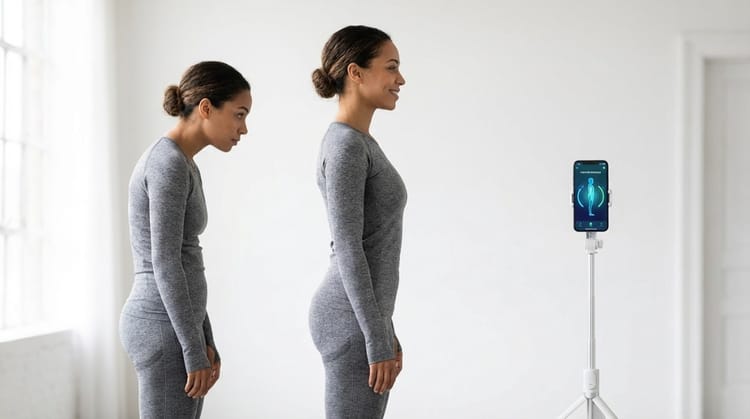
- 📸 Analyses your specific posture using your phone camera - identifying whether your primary driver is rounded shoulders, forward head posture, or both, and to what degree
- 🎯 Builds a personalised corrective program sequenced for your pattern - not a generic exercise list designed for a hypothetical average person
- 📈 Tracks your posture progress over time so you can see whether your alignment is actually improving week on week
Whether you are a desk worker dealing with screen-related neck drift, a parent carrying tension in the upper back, or someone who has tried exercise lists before and plateaued - Backed AI gives you a correction system, not just exercises.
Generic resources give you the what. Backed AI gives you the what, the why, and the exactly-when - personalised to your body.
Download Backed AI and start correcting your posture today. 👉 backedapp.com
FAQ
Q1: Can rounded shoulders and forward head posture be fixed at the same time?
Yes - and they should be. Both conditions share the same muscle imbalances and respond to the same corrective framework. Treating them together through a sequenced release-activate-strengthen approach is faster and more effective than addressing each separately.
Q2: What is the most important exercise for forward head posture?
The chin tuck is consistently recommended by physiotherapists as the highest-value single exercise. It simultaneously stretches the tight suboccipital muscles and strengthens the deep neck flexors - addressing both sides of the imbalance in one controlled movement.
Q3: Why do my back exercises not seem to fix my rounded shoulders?
Most likely because the chest and anterior shoulder muscles are still tight and restricting full scapular retraction. Strengthening exercises work best after releasing the opposing tight muscles. Add a doorframe chest stretch and upper trap stretch before your back work.
Q4: How long does it take to fix rounded shoulders and forward head posture?
Most people notice reduced tension within 2-4 weeks of consistent effort. Visible postural change typically takes 6-8 weeks. Sustainable, automatic correction - where neutral posture feels natural rather than effortful - generally takes 10-12 weeks of regular practice.
Q5: Is forward head posture causing my headaches?
Forward head posture places increased load on the cervical spine and can trigger tension headaches through suboccipital muscle compression. If you experience frequent tension-type headaches alongside neck stiffness and upper back tightness, posture correction is worth pursuing - but severe or frequent headaches should be assessed by a healthcare provider.