
Tech Neck vs Forward Head Posture: Are They the Same Thing?

You have probably heard both terms. Maybe you have Googled your own neck pain and found both staring back at you. They sound similar - but are they actually the same condition?
Tech neck and forward head posture both describe a pattern where the head shifts forward of the shoulders, but tech neck refers specifically to the cause while forward head posture describes the structural misalignment itself.
In short: tech neck is how you get there. Forward head posture is what you end up with.
Understanding the difference helps you treat the right problem - not just the symptom.
TL;DR
- Tech neck is caused by looking down at screens repeatedly over time
- Forward head posture is the structural spinal misalignment that results
- Both produce the same neck pain, headaches, and upper back tension
- You can have forward head posture without screens being the cause
- Correction requires targeting both tight and weak muscles
- Personalized programs outperform generic stretching routines significantly
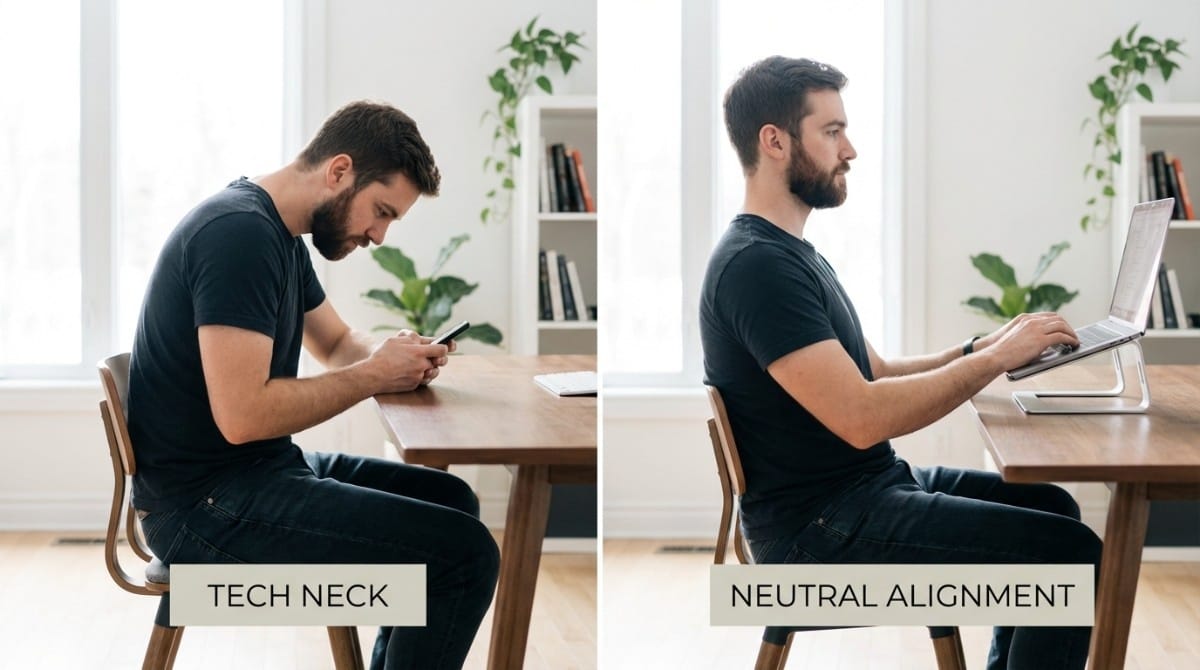
What Is Forward Head Posture?
Forward head posture is a musculoskeletal imbalance where the head sits in front of the body's vertical midline rather than stacked directly above the shoulders.
In a healthy spine, a plumb line dropped from your ear should pass through your shoulder, hip, knee, and ankle. In forward head posture, the ear sits noticeably ahead of the shoulder line.
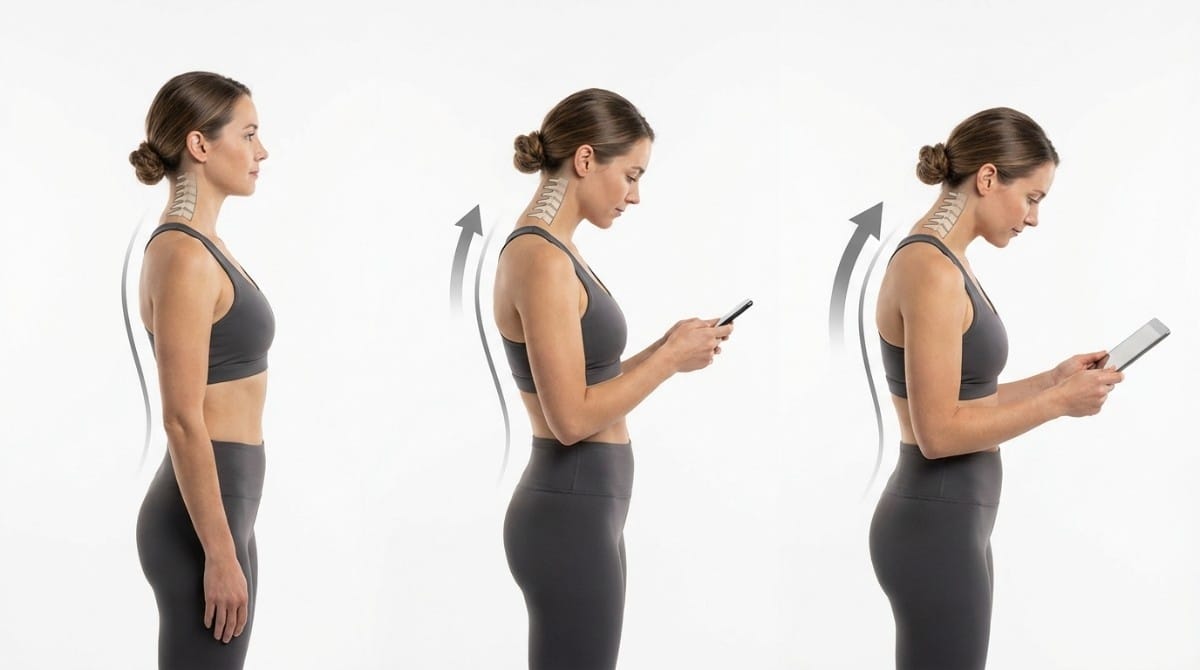
This shift matters more than it looks. For every inch the head moves forward, the effective load on the cervical spine roughly doubles. Posture specialists note that at just 15 degrees of forward head tilt, the neck structures bear the equivalent of approximately 27 pounds - nearly three times the load of a neutral head position.
Over time, this creates:
- Shortened and overactive muscles at the front of the neck
- Weak and overstretched muscles at the back of the neck and upper back
- Compressed cervical discs
- Altered shoulder mechanics
Forward head posture can develop from multiple sources - not just screens.
What Is Tech Neck?
Tech neck is a colloquial term for the pattern of forward head posture specifically caused by repeated and prolonged downward screen use. It refers to the same physical misalignment but names the modern trigger.
People develop tech neck by:
- Looking down at a smartphone for extended periods
- Working at a laptop set below eye level
- Reading on a tablet without adequate support
- Driving with the chin pushed forward
The term became common as smartphone use increased and physiotherapists began seeing younger patients with cervical pain patterns previously associated with aging.
🔑 Key Insight: Tech neck is not a diagnosis. It is a description of behavior. Forward head posture is the clinical condition that behavior produces. Treating "tech neck" without addressing the underlying postural misalignment is like treating a sunburn without moving out of the sun.
Tech Neck vs Forward Head Posture: What Is the Actual Difference?
| Feature | Tech Neck | Forward Head Posture |
|---|---|---|
| Primary cause | Downward screen use | Any sustained forward head position |
| Age group most affected | Younger adults, teens | All ages including older adults |
| Onset | Gradual from screen habits | Gradual from multiple lifestyle factors |
| Structural change | Cervical curve flattening | Cervical curve reversal in severe cases |
| Treatment focus | Habit correction + exercise | Muscle rebalancing + movement repatterning |
| Can occur without screens? | No - screens are the defining cause | Yes - also from driving, reading, work posture |
The practical takeaway: if screens caused your neck pain, you have tech neck. The structural result of that habit is forward head posture. Both need the same corrective approach.
Why Does Tech Neck Cause So Much Pain?
The pain from tech neck and forward head posture is not just muscular tension. It comes from a cascade of structural changes that build over months and years.
1. Muscle imbalance The muscles at the front of your neck - called the sternocleidomastoid and scalene - shorten and tighten from sustained forward position. The deep neck flexors and upper back muscles become weak from constant overstretching. This imbalance creates the pulling, aching sensation most people feel at the base of the skull and across the upper trapezius.
2. Cervical disc compression Forward head positioning compresses the front of the cervical discs unevenly. Research in musculoskeletal rehab shows this can accelerate disc degeneration over time if the misalignment goes uncorrected.
3. Altered breathing mechanics The forward head position restricts the natural expansion of the thoracic spine. Physiotherapists often observe reduced respiratory capacity in patients with significant forward head posture - meaning you are literally breathing less efficiently.
4. Headache patterns Tension at the base of the skull - the suboccipital region - frequently refers pain upward into the temples and forehead. Many chronic headache sufferers have forward head posture as a primary unaddressed contributor.
5. Shoulder and upper back involvement The head-forward shift pulls the shoulder blades apart and encourages rounded shoulders. What begins as neck pain often spreads into persistent upper back tension.
How To Tell If You Have Forward Head Posture
You do not need clinical equipment to check. Try this at home:
The Wall Test
- Stand with your heels, glutes, and upper back touching a wall
- Attempt to press the back of your head flat against the wall
- If your head reaches the wall naturally and easily - your alignment is reasonable
- If there is a significant gap, or you need to tuck your chin uncomfortably hard - forward head posture is likely present
The Photo Test Have someone take a side-profile photo of you standing naturally and relaxed. Draw an imaginary vertical line from your ear downward. If the line falls behind your shoulder rather than through it, your head is forward.
💡 If you want a more precise assessment, Backed AI uses your phone's camera to analyze your posture alignment and identify the degree of forward head shift - no guesswork involved.
Best Exercises for Tech Neck and Forward Head Posture (Quick List)
These exercises target both the tight muscles causing the pull and the weak muscles that have stopped holding your head in place.
- Chin tucks Pull your chin straight backward - not downward - as if making a double chin. Hold 5 seconds. Repeat 10 times. This is the foundational exercise for retraining deep neck flexor activation.
- Cervical retraction with wall support Stand with your back against a wall. Gently flatten your neck against the wall and hold for 10 seconds. Builds deep neck flexor endurance in the corrected position.
- Doorway chest stretch Arms at 90 degrees in a doorframe, step one foot forward, lean gently through the doorway. Holds for 20-30 seconds. Counteracts the chest and front-of-shoulder tightening that accompanies forward head posture.
- Thoracic extension over foam roller Place the foam roller horizontally under your upper back. Arms crossed over your chest. Allow your upper back to gently extend backward over the roller. Restores thoracic mobility that forward head posture restricts.
- Prone "Y" raises Lie face down with arms extended overhead in a "Y" shape. Raise your arms slightly off the floor while squeezing your shoulder blades. Strengthens the lower and mid-trapezius - the muscles most responsible for holding your head back.
- Suboccipital release stretch Gently tuck your chin and apply light fingertip pressure to the base of your skull. Hold for 30-60 seconds. Releases the tight muscles at the base of the skull that generate most of the headache pain.
- Scapular wall slides Stand against a wall with arms in a goalpost shape. Slowly slide your arms upward while keeping contact with the wall. Reactivates the serratus anterior and lower trapezius.

What Happens If You Ignore Tech Neck?
Most people dismiss early neck discomfort as normal tiredness. But forward head posture that goes uncorrected tends to progress - not stabilize.
Short term (weeks to months):
- Persistent neck stiffness and soreness
- Upper trapezius tension and trigger points
- Recurring tension headaches
- Shoulder tightness and reduced mobility
Medium term (months to years):
- Cervical disc compression and early degeneration
- Radiating pain into the arms or hands
- Chronic upper back pain from sustained rounded shoulder compensation
- Breathing pattern changes
Long term (years of misalignment):
- Accelerated cervical disc wear
- Nerve compression and potential cervical radiculopathy
- Structural changes that become progressively harder to reverse
Posture specialists emphasize that postural correction becomes more difficult - and takes longer - the more deeply entrenched the pattern becomes. Starting early is always the right call.
Step-by-Step Recovery Framework for Tech Neck and Forward Head Posture
Step 1 - Identify and accept the pattern Use the wall test or photo test to confirm forward head posture is present. Most people underestimate how far forward their head actually sits.
Step 2 - Reduce the trigger Raise your phone to eye level. Elevate your laptop screen. Change your car headrest position. Removing the repeated mechanical trigger is step one - without this, exercises alone will not hold.
Step 3 - Release the tight structures Begin with suboccipital releases, chest stretches, and thoracic mobility work. Tight muscles resist correction and need to be loosened before strengthening can be effective.
Step 4 - Rebuild the weak muscles Prioritize deep neck flexors, lower trapezius, and serratus anterior. These muscles are responsible for holding your head in its correct position. They need progressive loading to regain function.
Step 5 - Repattern the habit Set reminders to check your posture during screen use. Practice chin tucks throughout the day. The correction only sticks when it becomes your default position - not just something you do during exercise.
Step 6 - Track and progress Increase exercise intensity over 4-8 weeks. Without progression, the neuromuscular retraining plateaus.
Lifestyle Adjustments That Speed Recovery
Exercise alone is not enough. Physiotherapists often recommend pairing corrective exercises with these daily changes:
- Phone position: Hold your phone at eye level whenever possible
- Monitor height: Top of monitor should be at or just below eye level
- Pillow height: One pillow that keeps the cervical spine neutral - not two thick pillows that push the head forward during sleep
- Driving position: Headrest should support the back of the head, not push it forward
- Frequent breaks: Stand up and reset your posture every 30-45 minutes during screen work
Small consistent changes across all of these areas produce faster results than exercises alone.
Research & Expert Insight
Research in musculoskeletal health consistently shows that forward head posture is the most prevalent postural condition in screen-using populations. Studies in cervical spine biomechanics have demonstrated that sustained forward head positions significantly increase the compressive load on cervical structures, with the effect compounding at greater angles of tilt. Physiotherapists treating tech neck patients note that the condition rarely travels alone - it is almost always accompanied by some degree of upper thoracic kyphosis and shoulder rounding. Addressing all three components together produces significantly better outcomes than treating neck pain in isolation. Posture specialists increasingly recommend AI-assisted posture analysis tools that can quantify the degree of forward head shift and track measurable correction over time.
Final Takeaway
Tech neck and forward head posture are two names pointing at the same physical problem. Tech neck describes the cause - screens, sustained downward gaze, poor digital habits. Forward head posture describes the structural consequence - a head displaced forward of its natural position, loading the cervical spine far beyond its design capacity.
The solution is not complicated. But it requires specificity, consistency, and progression. Generic stretches help. Targeted programs built around your actual degree of misalignment help significantly more.
The earlier you address it, the easier the correction.
Why Most Exercise Plans Fail
Most people find three or four neck stretches online and do them for two weeks. The pain eases slightly. They stop. It comes back. Repeat.
Here is why that cycle keeps happening:
- No personalization: Generic exercises do not account for how far forward your head actually sits or which muscles are most inhibited in your specific case
- Wrong sequencing: Strengthening before releasing tight muscles is counterproductive - the tight structures override the weak ones
- No progression: The same exercises at the same intensity produce diminishing returns after the first two weeks
- No accountability: Without reminders and progress tracking, most routines disappear during any disruption to the daily schedule
The result is temporary relief - not correction.
📱 A Smarter Way to Fix Tech Neck
If you are serious about correcting forward head posture, the approach needs to match your specific pattern - not a generic one.
Backed AI uses your phone's camera to scan and analyze your posture. It identifies your degree of forward head shift and builds a personalized correction program around it - the right exercises, in the right order, with the right progression.
What Backed AI gives you:
- 🎯 AI posture scan that identifies your exact forward head angle - not a generic guess
- 📋 Personalized exercise routines sequenced correctly for your level and pattern
- 📈 Progress tracking that shows measurable improvement week over week
You do not need to guess which stretches apply to you. You do not need to figure out your own progression. The app does the heavy lifting so you stay consistent.
Download Backed AI and start correcting your posture today. 👉 backedapp.com
Frequently Asked Questions
Q1: Is tech neck the same as forward head posture?
Tech neck and forward head posture describe the same physical condition but from different angles. Tech neck names the cause - repeated downward screen use. Forward head posture names the structural result - a head displaced in front of the shoulders. Both require the same corrective approach.
Q2: How do I know if I have forward head posture?
Stand with your back against a wall. Your heels, glutes, and upper back should touch the wall. If you cannot bring the back of your head to the wall without significant effort or chin tucking, forward head posture is likely present. A side-profile photo is another reliable check.
Q3: Can tech neck be reversed?
Yes, in most cases. Forward head posture caused by screen habits responds well to targeted exercise, mobility work, and postural habit changes. The degree of correction possible depends on how long the pattern has been present and whether there is any structural disc involvement.
Q4: How long does it take to fix tech neck?
Most people notice meaningful improvement within 4-6 weeks of consistent, targeted exercise. Full correction of a well-established forward head posture pattern typically takes 8-16 weeks. Consistency and correct exercise sequencing matter more than intensity.
Q5: What muscles are most affected by forward head posture?
The deep neck flexors become weak and underactive. The suboccipital muscles at the base of the skull become chronically tight. The upper trapezius and levator scapulae are typically overloaded. The lower and mid-trapezius are weakened. Addressing all of these - not just the tight ones - is essential for lasting correction.